


Why capital fit matters more than capital access
 EXPERT INSIGHT: Would you dare to turn down an investment if it wasn’t the right fit? Galen Welsh of safe drinking water social enterprise Jibu did just that – and then secured a deal that put the business on the path to success. Brigit Helms explains why the right capital – not just any capital – is crucial for growing enterprises.
For many growth-stage social enterprises, access to capital is no longer the primary barrier. Fit is. The structure, expectations and timing of capital can determine whether a company scales, stalls or drifts from its mission.
Few entrepreneurs understand this more clearly than Galen Welsch, co-founder and CEO of Jibu. Recently, Jibu secured $1.2m in catalytic debt financing, led by Miller Center Capital and joined by Beneficial Returns and others – following Galen's decision to walk away from a funding opportunity that was not aligned with the company's long-term vision. Miller Center Capital initiated the transaction and led due diligence, derisking the investment for co-investors.
This financing builds on a relationship that began more than a decade ago when Jibu participated in Miller Center's 2014 accelerator programme, providing firsthand knowledge of the company and market that shaped Miller Center’s confidence in leading this investment. At that time, Jibu was still refining its model. Today, it operates nearly 200 locally owned franchises across eight African countries, delivering safe drinking water to more than 600,000 people each day. This kind of sustained, locally rooted scale is rare. What stands out even more is how they achieved it.
Learning the hard way
When Galen reflects on the early years of building Jibu, he is direct about what drives success or failure. Like many social enterprises operating in frontier markets, Jibu has had to navigate the realities of raising capital in environments where funding options are limited and often mismatched to business needs.
Galen’s advice is practical and grounded in experience: choosing the right capital partners is as important as securing capital itself. For entrepreneurs, that means ensuring that investors understand your company’s mission and long-term direction, not just your financial projections.
“A core challenge is that many investors apply a developed-market lens to frontier markets, over-weighting things like polished forecasts and underweighting things like on-the-ground know-how and resilience,” Galen observes.
Many investors apply a developed-market lens to frontier markets, over-weighting things like polished forecasts and underweighting things like on-the-ground know-how and resilience
Even investors’ perceptions of market size can be misleading. A company generating $100m in annual revenue may be dominant in its region while appearing relatively small from a global perspective. This disconnect can lead to expectations that are misaligned with both opportunity and risk. “Poor capital structure is one of the most common and overlooked reasons that businesses struggle and often the result of misaligned investment terms or undue control given to a funder far removed from day-to-day operations,” he says.
Equally challenging is the uncertainty that often accompanies the fundraising process itself. Galen describes situations in which investors spent months, sometimes years, on due diligence, only to change terms at the final stage. “The most difficult situations have consistently been when an investor strings us along and then changes terms, forcing us to walk away,” he says.
These dynamics are not just frustrating; they are costly. Companies make strategic decisions based on anticipated capital, such as entering new markets, expanding operations, or investing in growth. When the deal falls through, the consequences can be devastating, including lost resources and momentum.
The cost of misalignment
The damage from misalignment can be subtle at first, but over time, it shapes everything. As Galen puts it: “Sometimes even worse than a company failing is the mandatory mission drift that occurs when it has to prioritise short-term cash flow over long-term profitability or growth.”
Across sectors, this can result in companies shifting away from their core purpose, not because the model is flawed, but because the capital supporting it demands outcomes the business is not yet positioned to deliver.
In East Africa, this has played out across multiple industries. “I’ve seen solar companies shift to satellite TV subscription commissions as their primary revenue source, and agri-businesses whose core business has become real estate,” he notes. While investors play a role, entrepreneurs themselves are often part of the equation, feeling pressure to raise capital against overly ambitious projections and then struggling to meet them.
When the right capital enables
The recent investment in Jibu provides near-term working capital, enabling the company to add 22 new franchises in newer markets, such as Zambia and Ghana, where the potential for both impact and revenue growth is substantial.
“It has allowed us time to focus heads down on growing the business’s organic cash flow rather than spending time fundraising,” Galen notes. “The more impact we make, the more money we make in a 1:1 ratio.” By linking revenue growth directly to expanded access to affordable water, the model reduces trade-offs and creates a stronger foundation for scaling. Just as importantly, it gives Jibu a stronger footing with future investors – one built on demonstrated cash flow rather than projected potential.
Jibu’s journey illustrates what becomes possible when capital is structured to support, rather than constrain. It also reinforces a broader point. In impact investing, the question is not simply how much capital flows into the system, but how well that capital fits the businesses it is meant to serve. When that alignment is right, capital becomes a catalyst for growth, resilience, and lasting impact.
Brigit Helms is executive director at Miller Center for Global Impact
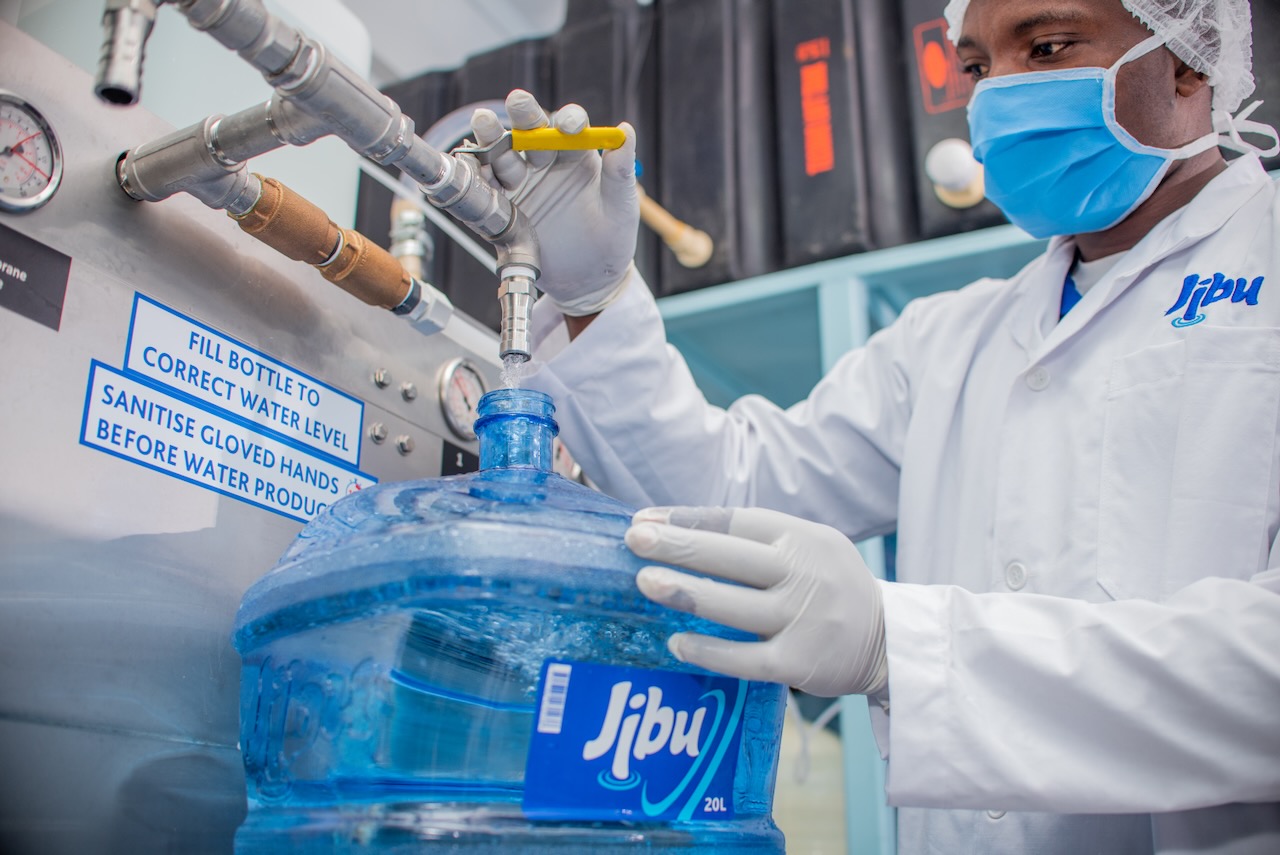
Header photo: A Jibu store in Rwanda where customers bring empty bottles and exchange for pre cleaned, filled, and sealed bottles. Central photo: the Jibu water treatment and bottle filling production process. Photos courtesy Jibu and Miller Center

| Ready to invest in independent, solutions-based journalism?
Our paying members get unrestricted access to all our content, while helping to sustain our journalism. Plus, we’re an independently owned social enterprise, so joining our mission means you’re investing in the social economy. |