


New momentum, difficult questions and “greenshouting”: actions for change from ChangeNOW 2026
As tens of thousands of delegates gather in Paris this week for the ChangeNOW conference, we dive into challenging conversations on financing nature restoration, how to revive collective action in 2026 and fighting “greenhushing”.
ChangeNOW is known for its sheer size, both in terms of the venue itself – the cavernous Grand Palais, built at the end of the 19th century for world expos – and the number of people attending, totalling about 40,000 this year. Hundreds of social enterprises and impact startups are presenting their work on the exhibition floor, while a remarkably diverse lineup of speakers share the stage in the various open platforms across the venue. Side events buzz in the balconies, workshops bring people close together in bubbles and entrepreneurs do their pitch in what looks like a little garden, real lawn and plants included.
Beyond the spectacle, this year’s attendees had hard questions to tackle. We dive into three such conversations worthy of attention.
How do we build back momentum for change in today’s world?
The summit is taking place at a time of geopolitical shock, in a context where environmental and social efforts have already been sidelined – and at times outright attacked – by governments and the private sector alike. It is very different from the circumstances of the early editions of ChangeNOW, nearly a decade ago, when momentum for climate action was in full swing.
Climate activist Luisa Neubauer (main photo), one of the stars of the youth-led global climate movement of the late 2010s, said the question wasn’t about “how to bring back 2019”, but about identifying the conditions that enabled the kind of momentum that led to the 2019 movement. What mattered was finding out what enabled this movement to brew – in 2017, when US president Donald Trump had withdrawn from the Paris agreement and Europe was facing an immigration crisis.
Momentum cannot be ordered. What we can do, however, is make it more likely to appear
“Momentum cannot be ordered. What we can do, however, is make it more likely to appear. This means thinking about conditions of change, instead of single moments of change.”
 Sarah Schwimmer (left), co-lead executive at B Lab, highlighted the importance of infrastructure for collective action – a shared framework, such as the B Corp movement. “Social movements historically have worked best and have had the most structural and sustainable, lasting change when there has been a shared framework.”
She said she experienced current shifts first-hand in the US, and that while their scale shouldn’t be underestimated, “we can also benefit from perspective and understand that this is indeed a moment”.
Looking at the history of collective action was important to bring some context, and such work should be seen as a multi-generational effort, she argued. “When we talk about collective action, sometimes we don't all get to live to see the next step… The work is never done.”
We don't want to waste this crisis, and recognise that we have the opportunity to bring more people into this space
The current crisis and rollbacks in environmental action are rooted in “tremendous inequality”, she said – and in the past, such situations have led to positive change. She pointed to the early 20th century in the US, when huge monopolies were driving wealth inequality and the erosion of civil rights, a situation not that dissimilar to today’s. Within a decade, social movements drove change in policy, an expansion of voting rights and a reduction in wealth inequality.
“We don't want to waste this crisis, and recognise that we have the opportunity to bring more people into this space, because more people are feeling the challenges of the climate crisis and wealth inequality more acutely than ever.”
How finance pioneers are making nature bankable – and is it the right thing to do?
 According to the UN, for $1 invested in nature-positive activities, $30 are invested in nature-harming ones. How do we mobilise more money towards activities that benefit the planet? Value nature differently, said Elena Doms (pictured above), director of Europe at land restoration nonprofit Oxygen Conservation, in a keynote on Tuesday.
Nature is currently valued, she explained, but in a destructive way. “We cut the forest and we sell it, we extract oil for energy, we grow our food in soil and we put it on the shelves of the supermarkets – that is pricing nature every single day,” she said. “The problem is we price it wrong, and that encourages wrong behaviour. Our current pricing system is destructive.”
The problem is we price it wrong, and that encourages wrong behaviour
But new business models like Oxygen Conservation’s show nature can be seen as infrastructure, and an asset that yields returns, she argued. Oxygen Conservation is a nonprofit that uses private capital to buy land to restore natural habitats such as forest and peatlands, and uses profits from nature-positive activities, such as carbon credits, eco tourism and renewable energy, to fund further land acquisition. It currently manages 50,000 acres of land, with a portfolio value of £400m.
 But the way financial markets work could be seen as incompatible with nature restoration, said Hilda Liswani (pictured, right), founder of WeBloom: “There is an ecological reality and a financial logic that are sometimes in competition with each other.” She points to time horizons for example – where financial markets are designed for quarterly returns, while nature can take decades to yield results.
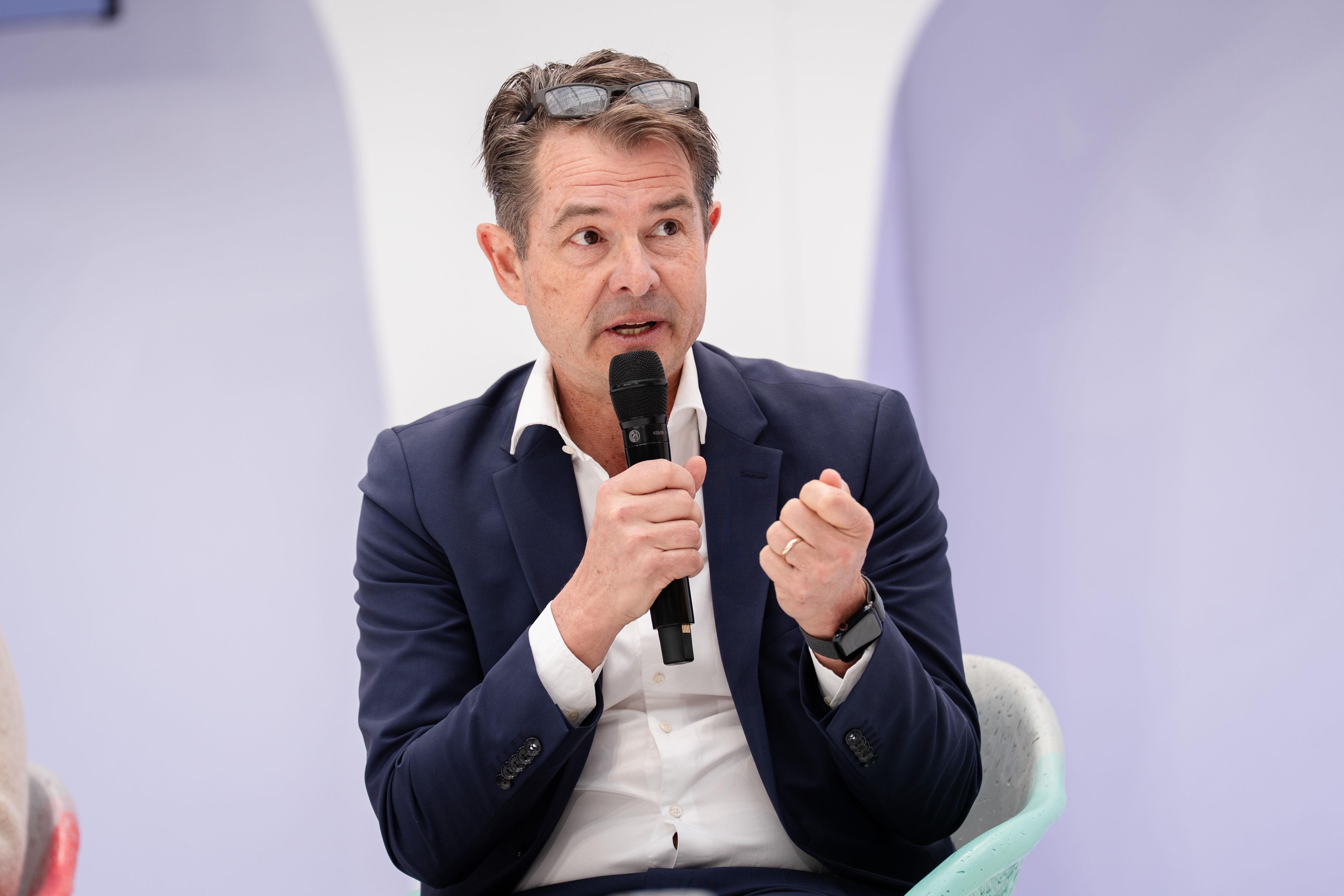 Martin Stuchtey (pictured left), CEO of the Landbanking Group, a technology company that seeks to make biodiversity measurable and investable, said markets were actually quite adaptable. Some forms of capital, such as pension funds, invest in the long term by design, he explained. And if we consider nature depletion as a risk – such as insurance risk or supply chain risk – “every unit of nature takes a unit of risk out of the system, which makes you more investable, more insurable”. But system redesign to an extent is still needed to get there, he acknowledged.
The perspective from Indigenous rights and climate activist Xananine Calvillo Ramirez (pictured below) cast doubt over whether making nature fit into markets – even for the sake of mobilising more money for it – was the right thing to do. Calvillo Ramirez is the founder of the Jns Tsjo Collective, an Indigenous women and youth-led collective that protects traditional knowledge in the Tehuacán Valley in Mexico.
She argued that our relationship to nature, like the spirituality and energy associated with it, are priceless. “If we were to put a price tag on nature, what is then the price that we will put on our own life?” she asked.
“Rather than thinking of a solution to a problem that the system [capitalism] created, we need to listen to a different system,” she added. “The protection of nature does not need to be valued, but the question has to be different… Rather than thinking, ‘How are we going to make nature marketable, desirable to investors?’, we need to think [about] how we're going to make an economy that is aligned with nature. That is precisely what the economic systems from our peoples or territories around the world [are] doing.”
If we were to put a price tag on nature, what is then the price that we will put on our own life?
She gave the example of the food systems: Indigenous peoples have a knowledge on how to produce their food in a way that also preserves nature, which is core to their sovereignty and sustainability.
But, she reminded the audience, while the global north was concerned about an incoming end of the world in the face of a planetary crisis, for Indigenous peoples, “the world ended 500 years ago”.

The antidote to greenwashing and greenhushing
Greenwashing is a well-known phenomenon, but recent years have also seen the rise of “greenhushing” – when companies or organisations do not communicate on their environmental efforts for fear of a political backlash, or due to confusion around regulation in some countries.
Data shows that climate progress is continuing, said Thea de Gallier of Creatives for Climate, a global network of communications professionals dedicated to climate action and justice. “But the visibility around that progress is disappearing, and when credible and responsible actors go quiet, it creates an information void for high-carbon, false narratives and misinformation to step in.
There's a real danger... because silence doesn't just reduce visibility, it reshapes reality
“So this isn't just about one actor going quiet. It's about a whole movement that starts greenhushing… We lose our collective influence and power, and there's a real danger in that, because silence doesn't just reduce visibility, it reshapes reality.”
This is where the concept of “greenshouting” comes in – defined by the Climate Dictionary as “boldly celebrating real progress in your business's sustainability whilst backing it up with verified impact.”
In response to this issue, Creatives for Climate, B Lab and creative agency Nice and Serious launched a guide to greenshouting at the event, a resource for communications professionals to support organisations to confidently speak about their climate efforts.
The guide describes greenshouting as “the practice of communicating sustainability efforts openly, accurately and courageously, grounding claims in evidence, acknowledging challenges, and strengthening a transparent information ecosystem”.
If greenwashing was saying more than you were actually doing, and greenhushing became doing more than you were actually talking about, greenshouting is... just telling compelling stories about what it is you are actually doing
 Charlotte Levitt (pictured), global director of marketing and communications of B Lab, explained: “If greenwashing was saying more than you were actually doing, and greenhushing became doing more than you were actually talking about, greenshouting is quite simply, just telling compelling stories about what it is you are actually doing.”
The guide suggests three steps towards greenshouting: first, establishing whether or not the organisation actually has a strong sustainability strategy in place that yields results; then having facts to back its claims – and even better, obtain third-party certification. Finally the guide suggests seven “dials” to bear in mind in communications campaigns about environmental action – including tone, emotion and humility.
Beyond the conversations on stage, we have spent time meeting the entrepreneurs on the exhibition floor – keep your eyes peeled on Pioneers Post to find out more about their perspective.
Photos: Guillaume Fontaine / Memento; Marie Brunel Marie; Françios Durand

| Ready to invest in independent, solutions-based journalism?
Our paying members get unrestricted access to all our content, while helping to sustain our journalism. Plus, we’re an independently owned social enterprise, so joining our mission means you’re investing in the social economy. |