


Bohemian FC: the game-changing football club introducing a new economic vision to Dublin
The goal of a Dublin football club is to transform the entire city’s economy, taking inspiration from Spain’s Mondragón Corporation, and movements in Preston, Scotland and beyond. We explore Bohemian FC’s plans to launch an insurance mutual and a food enterprise, positioning itself at the vanguard of the global community wealth building movement.
Home fans brandishing burning red flares in one stand, plumes of green smoke billowing from the away stand, raucous chanting from both sides. The scene which welcomed the football players onto the pitch was exactly what you might expect from what was described to me as “the fiercest rivalry in the country”.
The match is Bohemian FC vs Shamrock Rovers, on a heatwave-baked night in May in the Republic of Ireland. North Dublin vs south Dublin, a rivalry stretching back to the clubs’ first encounter in 1915.
But, even within that context, the banner unfurled by the Bohemian FC fans was confronting. If the Shamrock players, nicknamed the Hoops, had looked towards the home fans, they would have come face-to-face with an image of a balaclava-clad man pointing a gun at them, surrounded by the words: “See a Hoop, shoot a Hoop”.
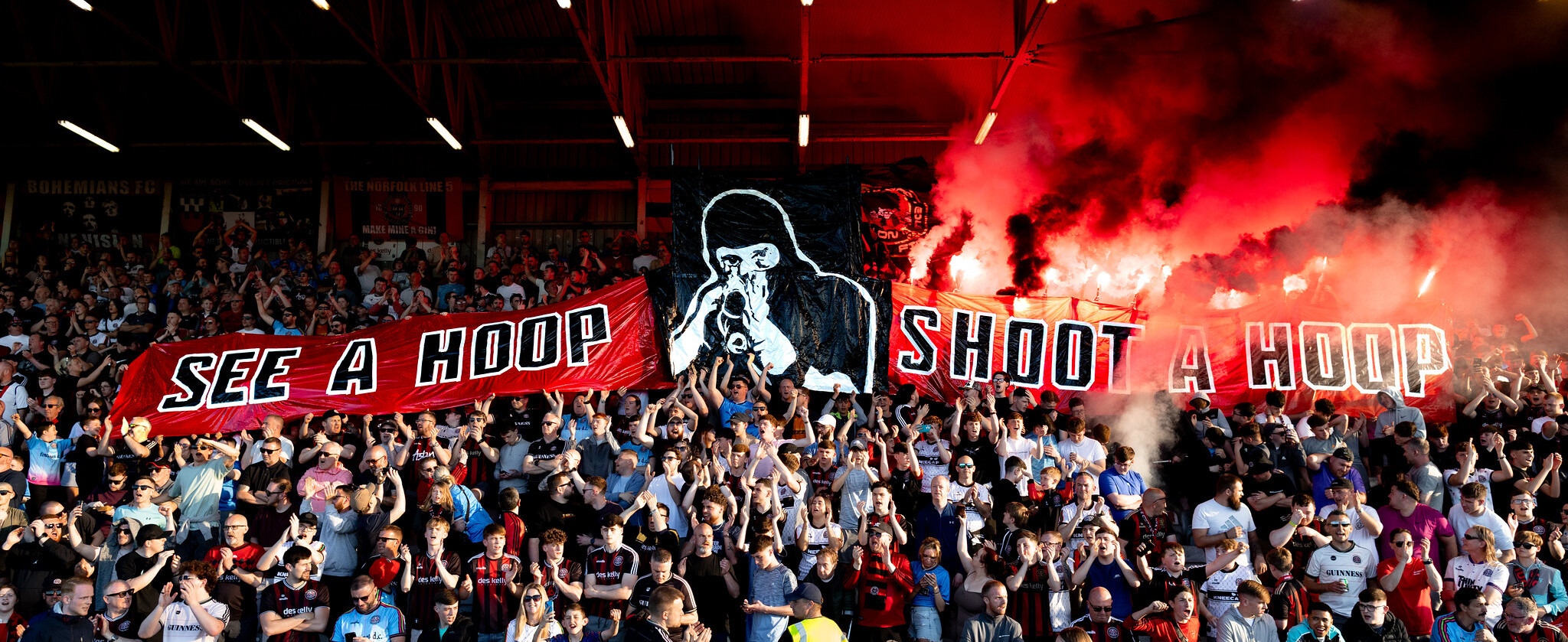
The fan culture at Bohemian FC can appear at odds with the progressive politics championed by the club (credit: Darren O'Hanlon, Flickr)
Whether you see that banner as alarming in its evocation of the imagery of very real violence within living memory in Ireland, or merely the spikiest end of football ‘banter’, it is certainly a far cry from the language of inclusivity and solidarity you might expect from an economic and climate justice movement.
Yet, with the launch of its very own community wealth building strategy in May, Bohemian FC is not just a part of that movement, but is pioneering it both in Ireland and in the football industry.
Community wealth building is an economic model which seeks to redirect wealth back into local economies where it is generated, and places the control and benefits of that wealth into the hands of local people.
Bohemian FC is positioning itself as a focal point for creating an economic transformation across Dublin. Through its strategy, Bohemian FC is launching three enterprises – an organisation to deliver the work, an insurance mutual and a food enterprise – alongside putting in place the governance, systems and infrastructure to support a wider ecosystem, with the aim of keeping €250m in Dublin’s economy by 2050.
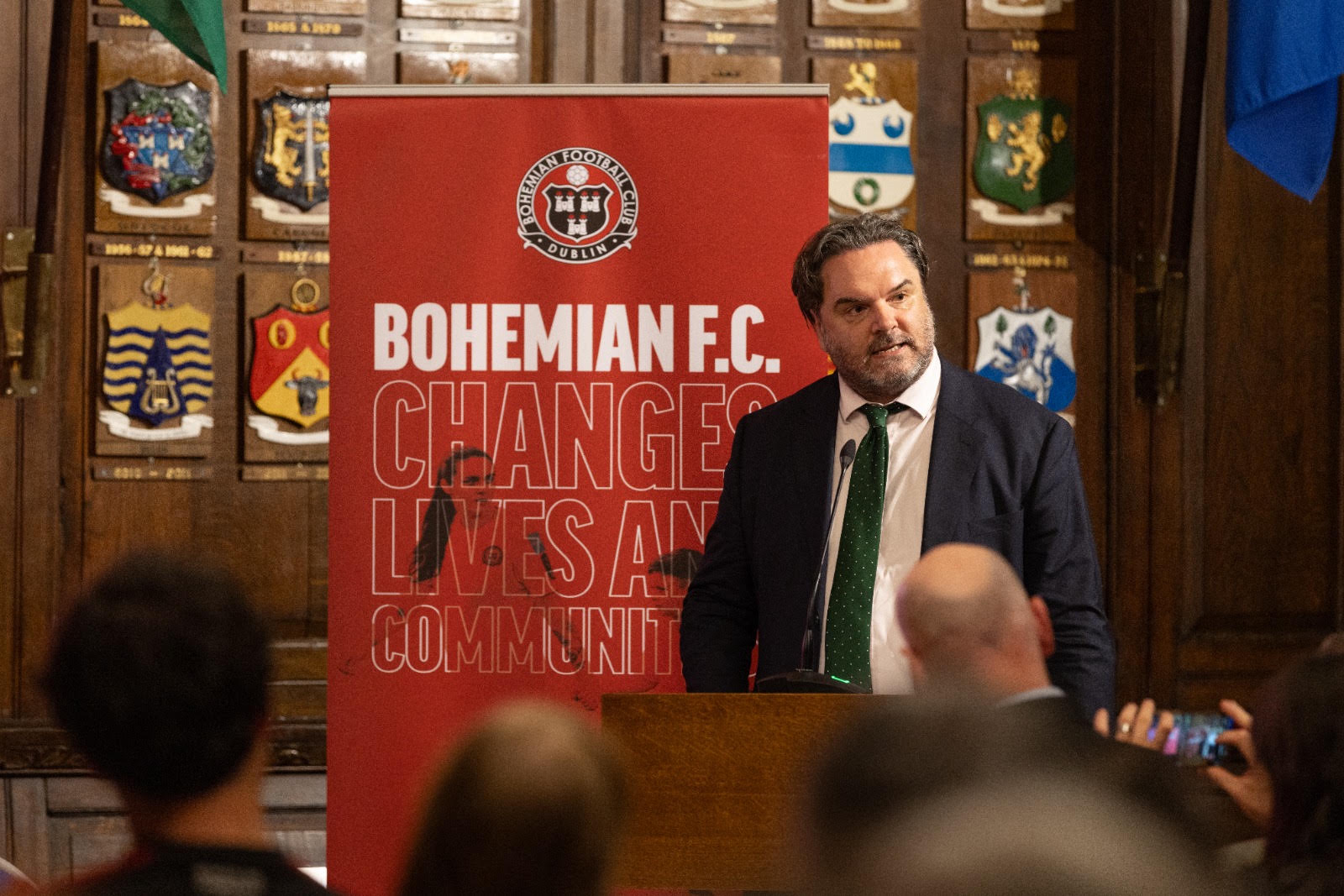
Joe Guinan, president of think tank the Democracy Collaborative, said Bohemian FC's community wealth building strategy was "profoundly important" (credit: the Democracy Collaborative)
At the strategy launch Joe Guinan, president of the Democracy Collaborative, a think tank championing community wealth building across the world, lauded Bohemian FC for its “profoundly important and catalytic role” in promoting the economic model in Ireland.
The football industry is known for its rapacious extraction of profit from fans, and there’s been much reporting on the endless greed displayed by FIFA at this summer’s World Cup. So how has a professional football club become a leading influence in a burgeoning progressive economic movement?
The Bohemian FC story holds lessons not only for football clubs looking for ways to truly serve their communities, but for any organisation aiming to influence economic systems change.
The “see a Hoop, shoot a Hoop” banner also illustrates a tension at the heart of Bohemian FC's transformation and one which anyone engaging in community wealth building must tackle: Who is included, or excluded, from a community? Who gets to decide on a community’s identity? And what institutions can enable social innovation to go mainstream?
What is community wealth building?
Community wealth building prioritises communities having direct ownership and control of their assets. The model seeks to harness the economic leverage of large ‘anchor’ organisations (for example local councils, health boards and colleges) to build momentum behind a virtuous cycle of local spending and wealth retention.
The model has five core “pillars”: progressive procurement; community-based business models like social enterprise and cooperatives; fair employment practices (including paying employees a living wage); using land in a community for social or environmental benefit; and keeping capital local by supporting credit unions, community banks and investing local pension funds into regional projects.
Key examples of community wealth building in action include work by the Evergreen Cooperatives, the Democracy Collaborative and local partners in Cleveland, US (known as the “Cleveland Model”), and Preston City Council with the Centre for Local Economic Strategies in the UK (the “Preston Model”).
Scotland became the first country in the world to legislate for the implementation of community wealth building at a national, regional and local level when the Community Wealth Building (Scotland) Bill was passed in February 2026.
How the Bohs will build community wealth
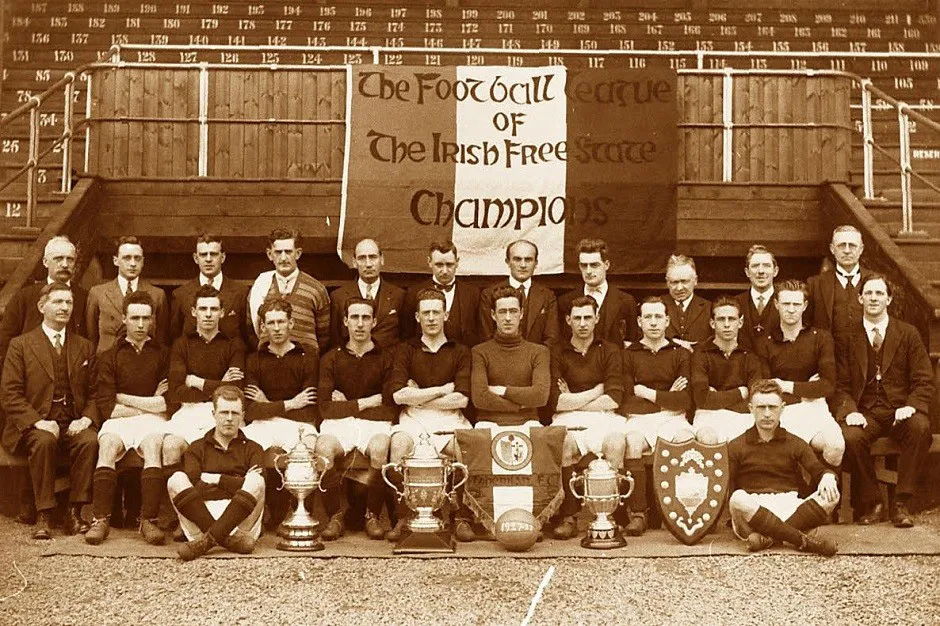
Bohemian FC has been member-owned since it was founded in 1890. The club won three League of Ireland titles in the 1920s (credit: Bohemian FC)
Bohemian FC, nicknamed the Bohs and based in the historically working class Phibsborough area of Dublin, has been member-owned since the club was founded in 1890.
The Bohemian FC community wealth building strategy, which has received the support of Dublin City Council, states its mission as building the “foundations of a democratic, community-owned economy in Dublin that tackles climate change and inequality together”. The aim is “to help stitch a new social fabric in Dublin in which local ownership grows, public spending recirculates, climate action delivers material benefits, and more people can see themselves as participants in building a safer and fairer future”. In practice, it says this means providing decent jobs, lowering people’s household costs, building stronger public services, expanding cooperatives and keeping wealth circulating locally.
From September 2026 the community wealth building strategy will be in a startup phase, planned to run until September 2029. That phase will focus on seven key areas of work: governance; education and community participation; policy and systems change; community ownership; monitoring, learning and evaluation; launching a food systems enterprise; and setting up an insurance mutual.
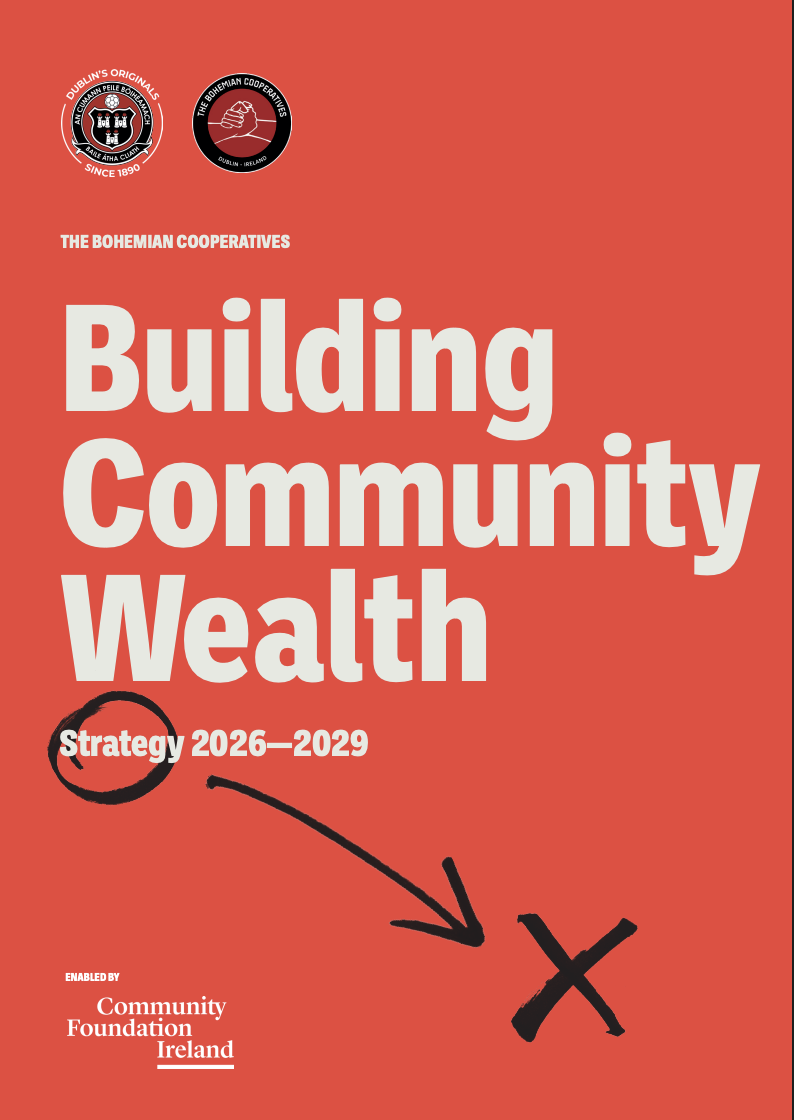
A new legal entity – Bohemian Cooperatives – will deliver the startup phase of the strategy. A not-for-profit company limited by guarantee, Bohemian Cooperatives will serve as the governance and fiduciary home of the work and recipient of startup funding.
Inspired by the famous Mondragón Corporation in the Basque Country, Spain, Bohemian Cooperatives is conceived of as the backbone of a network of cooperatives and other enterprises delivering community wealth building across Dublin. Rather than serving as a centralised, controlling organisation, says the strategy, it will provide core operating capacity for new enterprises in the network.
- Read our Impact 101: What is a cooperative?
At launch, those organisations are the food systems enterprise and the insurance mutual. The strategy details how Bohemian Cooperatives can develop the conditions and support structures for more enterprises to be launched in the future.
The food systems enterprise is intended to provide catering for schools, hospitals and other large institutions. The strategy identifies such a business as a quickly launchable and viable trading enterprise.
It also opens a wider route into food system restructuring in Dublin, connecting public procurement, nutrition, decent work, local production and shared ownership. If successful, and established quickly, the ambition is that the food systems enterprise will serve as a useful example of community wealth building initiatives for potential partners and communities.
Like the food systems enterprise, the research behind the strategy suggests an insurance mutual would be immediately viable, claiming it could reach profitability by year three, making €2.1m after-tax profit by year five. The aim is to make insurance more available, accessible and affordable for people in Dublin.
How football can take climate justice outside its bubble
Seán McCabe (pictured), climate justice and sustainability officer at Bohemian FC and the architect of its community wealth building strategy, says he was initially laughed at for taking a climate justice role at a football club. He began as a volunteer in 2021, having previously worked in climate justice for both the UN and the Mary Robinson Foundation. Those roles, he says, had shown him that while there were lots of high-level conversations about the just climate transition, there were few grassroots examples of it actually being put into practice.

Now, he believes, the scepticism he received shows he was successfully taking climate justice concepts “outside of their bubble”.
Having initially conceived of Bohemian FC as being a community wealth building ‘anchor’ organisation, McCabe discovered it was already using local suppliers for most of its procurement, such as food vans and cleaning services. Instead, he realised, the Bohs’ real potential was as an organiser and advocate for the model at a city-wide level.
“Football matters to people, and if you treat it with respect you can access transformative capacity. Football clubs can be this beating heart of cultural organising,” he says. “We need institutions like that so badly, because to transition our world to a safe and secure future for our children and grandchildren, we don't have the time to build these types of institutions and then have those institutions gain the trust of the people.”
What if we own the local economy like we own this football club? What could we do then?
McCabe was a member of the Bohs before he began volunteering, and was keen to emphasise that Bohemian Cooperatives’ work will be co-designed with the community.
“We've no desire to co-opt something really good for our own ends,” he says, “but actually to enter a dialogue with the community from this point and say, ‘what if we own the local economy like we own this football club? What could we do then?’”
The community wealth building strategy says that between now and 2045 it will require €22m in investment to deliver. Bohemian Cooperatives will be entirely grant-dependent for the first three years, to the tune of €890,063 in its first year, dropping to 37% by year 10, but by 2045 will be self-sustaining.
Although Bohemian Cooperatives is not yet investment-ready, McCabe is keen to open conversations with social and impact investors to explore the possibility of future deals.
Values-led or virtue signalling?
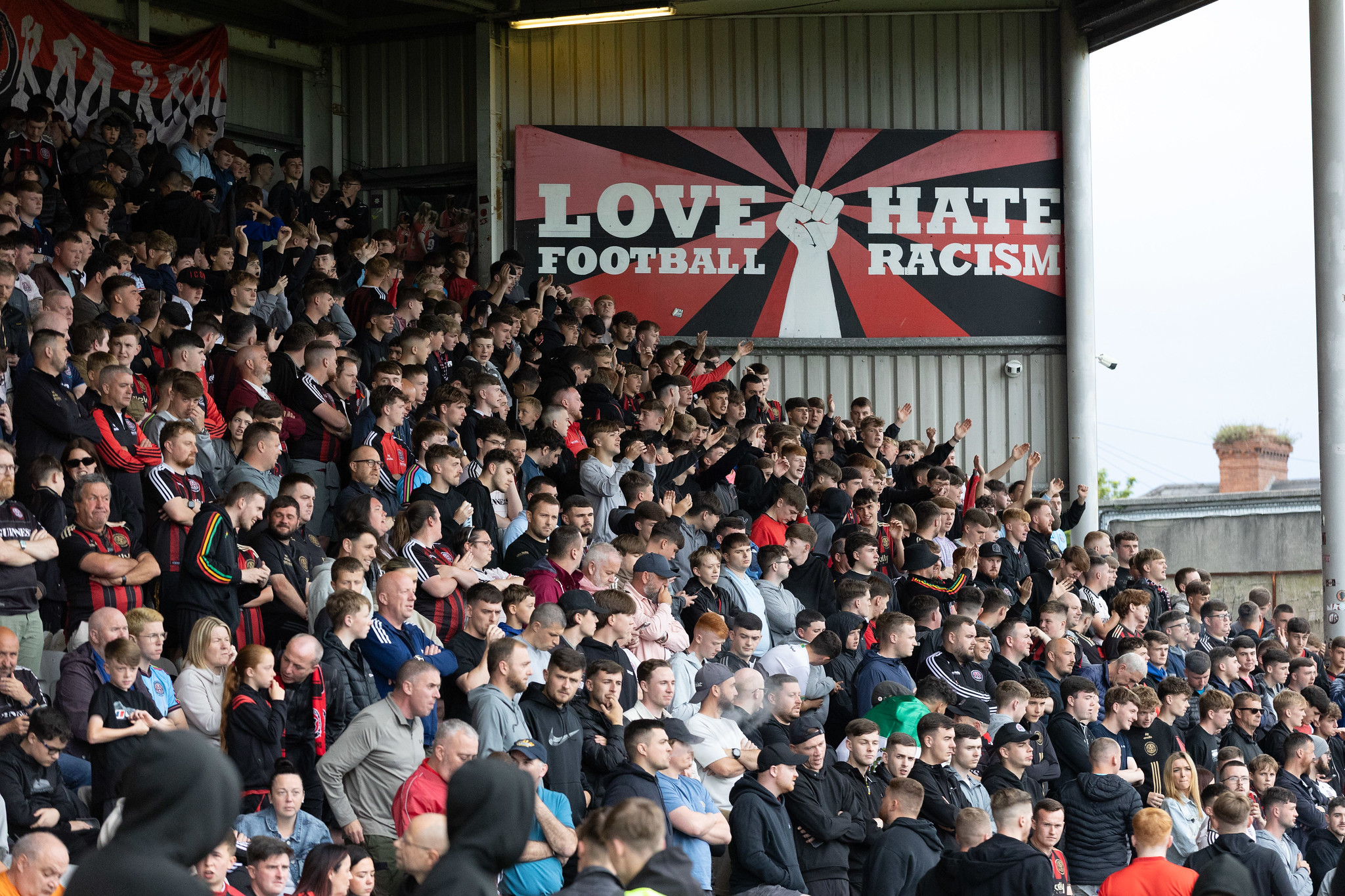
Bohemian FC has placed a number of signs and banners in support of political and social causes around its stadium at Dalymount Park, Dublin (credit: Darren O'Hanlon, Flickr)
Phibsborough has seen significant gentrification in recent decades, a process which has coincided with a deliberate and commercially successful foregrounding of progressive politics by Bohemian FC.
In the early 2010s, despite recent on-field success, Bohemian FC was on the verge of bankruptcy, with just over 400 members at its lowest point. Daniel Lambert, now the club’s chief commercial officer, joined the board in 2011 and is credited with leading the strategy of embracing progressive causes, including anti-racism, LGBTQ+ rights, refugee rights and more.
Visual advocacy for those causes is on display everywhere at Dalymount Park, the Bohs’ stadium. At the game against Shamrock Rovers, in contrast to the fans’ “see a Hoop, shoot a Hoop” banner, the club has displayed a large “love football, hate racism” sign, a large flag celebrates the Gay Bohs (the first LGBTQ+ supporters group in the League of Ireland) and fans proudly wear Bohemian FC shirts supporting Gaza, trade unions and more.
That strategy is a key part of how Bohemian FC has gone from almost going out of business to where it is now: the most commercially successful club in the League of Ireland. The club’s most recent accounts show it made €1.5m profit in 2025, with merchandise sales a significant part of that, despite not having qualified for any lucrative European competition that year.
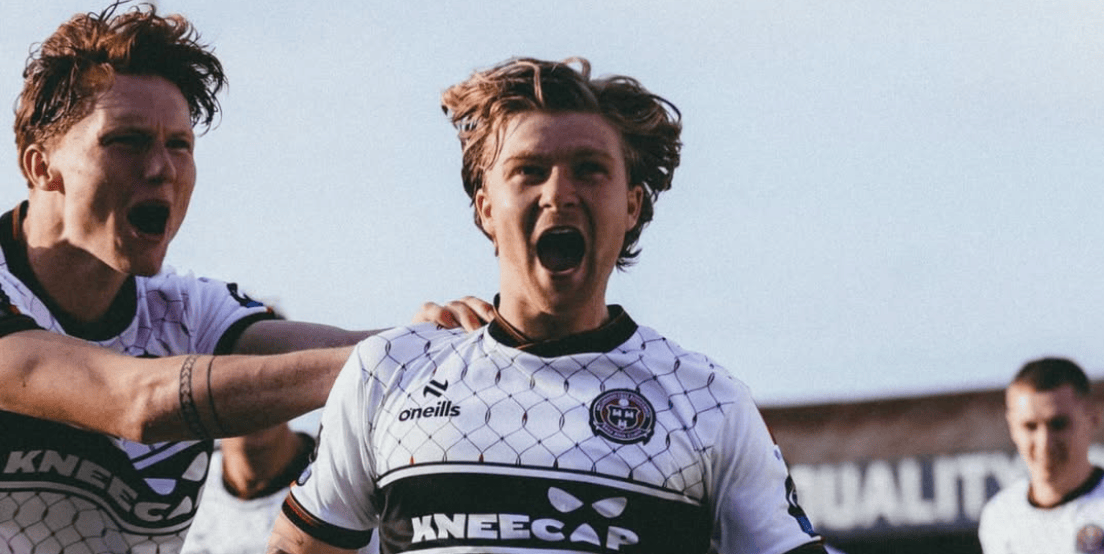
In recent years Bohemian FC shirts have featured featured logos of popular bands including Kneecap, Oasis and Fontaines DC (credit: Bohemian FC)
Alongside the shirts promoting social and political causes, the club has had great success with jerseys bearing the logos of popular bands, including Kneecap (also managed by Lambert), Oasis and Fontaines DC. Bohemian FC's membership has swelled to more than 3,000.
The club is assured in its stance that the campaigns are public expressions of its members’ values, but Lambert is also on the record stating there is a commercial strategy at play. In 2025 he told the LA Times: “I can’t conceive of any way where Bohs could be in a position that a fan of Bayern Munich in Munich or a fan of Manchester United in Manchester would want to buy a Bohs shirt for football reasons. But if you bring it to an emotional space, there are people who care…If we can connect with people in different countries and cities around the world on that basis, our potential market is huge.”
A quick look at the comments on coverage of the financial success of the strategy reveal some significant pushback. Under a Facebook post by media outlet Sports Bible Ireland about the Bohs’ 2025 finances, one user commented: “Lots of money to be made virtue signalling.”
There’s plenty of evidence online of longtime Bohs supporters feeling “their” club is championing causes they feel don’t represent them. Roddy Collins, Bohemian FC's manager when the club won the Irish league title in 2000/01, has said the club has become too politicised. People outside the club allege the move is cynical and is forcing a disingenuous identity on traditional Bohs fans.
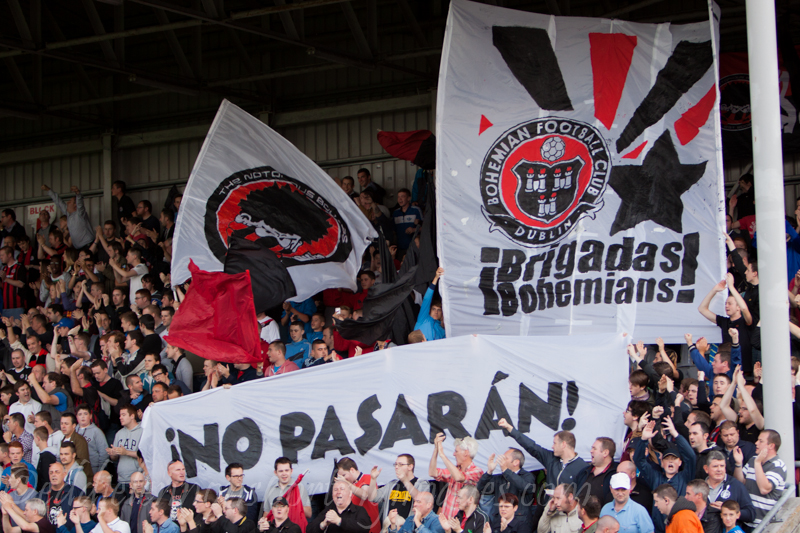
Bohemian FC says the social and political causes it champions are expressions of its fans' values (credit: Bohemian FC)
From a community wealth building perspective, the most urgent criticism to dissect is that the club’s cultural transformation, and attendant engagement of new fans, is part and parcel of the gentrification of Phibsborough.
Evidence that the club’s progressive politics are more than surface level come from its community arm, Bohs in the Community, which runs educational workshops about migration in nearby schools, supports the rehabilitation of men in north Dublin’s Mountjoy prison, organises football activities for people with disabilities, and more.
That work is similar to the community and charity programmes delivered by many professional football clubs. But the Bohs’ community wealth building strategy takes this a step further and McCabe argues that by seeking to play a proactive role in supporting the people of Phibsborough, rather than merely chasing trophies, the club is now reconnecting with its history and purpose.
He says it’s about identifying what was good about the club in the past: “I think someone from the 1950s would probably recognise it as closer to what they felt they were a part of with Bohemians back then than they would have if they came along in the 2010s.”
The significant work and resources that have gone into the Bohs’ community wealth building strategy show the club’s promotion of progressive values goes far beyond the accusation of “virtue signalling”, argues McCabe. “It has always been very important that we walk the talk, and nobody is here to promote stuff just because it's easy. We want to do the hard stuff,” he says.
Thinking beyond the conventions of modern football
Mary Robinson (pictured), former president of Ireland, former UN high commissioner for human rights, co-founder of the Elders (an NGO made up of noted public figures and world leaders) and McCabe’s old boss, endorsed the Bohs’ community wealth building strategy in the document’s foreword.

“I commend Bohemians…” she writes, “for its willingness to think beyond the conventions of modern football and to imagine what becomes possible when communities are trusted as builders of their own future.”
McCabe hopes Bohemian Cooperatives’ work can serve as a point of inspiration: “The football club provides you with the cultural legitimacy to do a lot of really exciting work. We think if we can prove that this works in the next five or six years, that football gives us an amazing network to spread it around the world.”
Back at Dalymount Park in May, the Bohs’ conceded a last minute goal to lose 2-1 to Shamrock Rovers. Having won the League of Ireland Premier Division five times the past six seasons, and the Irish top flight 22 times in their history, Rovers are by far the most successful club in the country on the pitch, much to Bohs fans’ chagrin.
Through its community wealth building strategy, the Bohs’ are aiming for a different goal: not just financial sustainability, not just growing its fanbase, but to play a leading role in delivering prosperity and climate justice for its community.
Top image and image of Seán McCabe courtesy of Bohemian FC
Image of Mary Robinson credit: UK Government, Flickr (CC BY 4.0)
Create your own user feedback survey

| Ready to invest in independent, solutions-based journalism?
Our paying members get unrestricted access to all our content, while helping to sustain our journalism. Plus, we’re an independently owned social enterprise, so joining our mission means you’re investing in the social economy. |
