

The Editor's Post: Can impact investing meet the needs of the Middle East?

Debates about how to mobilise impact investment and the news from the AVPN conference in India: this week's view from the Pioneers Post newsroom.
Impact investors are scared to invest in projects seeking to create peace in the Middle East, due to concerns about political and reputational risks.
That’s the view of Gidon Bromberg, co-founder and Israel director of EcoPeace Middle East, a charity which aims to deliver stability to the region through private investment in climate security projects.
When I interviewed him for my story about EcoPeace Middle East’s work, published this week, Bromberg expressed his view that impact investors are not fulfilling their role of making investments which accept a risk mainstream investors wouldn’t accept, in the name of generating positive social or environmental impact.
“The lack of investment in peace building, and the lack of understanding that that investment is an investment in security, is mind boggling,” he said. “When you invest in peace, you might be seen as taking sides, as if peace belongs to one side. Of course, there are those that don’t want to see a two-state solution [for Israel and Palestine] on both sides, and they have allies and alliances globally, so there’s also greater risk for the investors that are not present in issues that are considered more consensus and mainstream.”
Bromberg believes impact investors are also discouraged because impact measurement in peace building is much less quantifiable than in areas which receive impact investment more commonly, like health or financial inclusion.
Data shows that there is a relative lack of impact investment targeting SDG16, which covers peace, justice and strong institutions. In April 2025 my Pioneers Post colleague Laura Joffre covered a report from Phenix Capital Group, which found that, out of a database of 2,900 impact funds, only 40 targeted SDG16. But, the report doesn’t detail why, and it is possible that organisations and projects targeting that goal are unable to deliver the necessary financial returns to attract investment. The report also found only 67 of the funds targeted the Middle East.

In May of this year I covered a different argument about how impact investing is failing to fulfil its promise in the Middle East. A report published by Impact Jordan argued that to meet the needs of the communities it seeks to benefit, impact investment must be rooted in local experiences and culture, rather than defined by global north frameworks.
When the report was published Andrew Gharaibeh Collingwood, co-founder of Impact Jordan, told me: “If a holder of money from outside Jordan wants to be able to come into a market like Jordan and really invest in impact that is locally relevant and locally scalable, there has to be a trade off,” referring to the need of giving up some control over the definitions, tools and metrics of impact to align with local values.
Debates about how to mobilise impact investment have also been taking place in New Delhi this week, where AVPN is holding its annual conference (as AVPN CEO Naina Subberwal Batra stated at the organisation's 2024 conference, it considers the Middle East as “West Asia” and as such part of its network).
Kenan Machado is covering the conference for Pioneers Post. On Tuesday he reported that Subberwal Batra emphasised the need to build and create an impact investing ecosystem where “Asian wealth holders really see themselves as the prime drivers of change.”
Meanwhile, her colleague Ramkumar Venkatramani told the conference: “Asia is now building infrastructure and architecture for its own markets. The future of impact investing is not going to be just imported. It's going to be designed here, executed here, and then shared with the rest of the world.”
As the human cost of conflict, climate change and other global threats grows ever more severe and urgent, all wealth holders committed to positive change – whether investing from the outside or building new impact infrastructure from within – must be willing to question established approaches and respond with the understanding, innovation and courage that the task demands.
This week's top stories:
Can the business of climate security drive peace in the Middle East?
Asia's impact network tells its own billionaires to step up
Pride is over – will social investors ensure the work continues?
The Impact World this Week: 28 August 2026
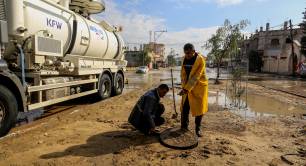
Top image: Gaza, August 2022 (credit: Mohammed Ibrahim, Unsplash)

| Ready to invest in independent, solutions-based journalism?
Our paying members get unrestricted access to all our content, while helping to sustain our journalism. Plus, we’re an independently owned social enterprise, so joining our mission means you’re investing in the social economy. |