

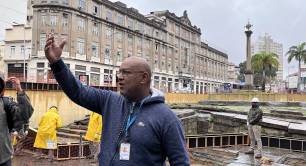
Challenging assumptions: Latimpacto conference delegates rethink scale, systems and strategies for the future
Travel is said to broaden your horizons, and the Latimpacto conference in the Brazilian city of Manaus this week gave delegates an ideal opportunity to bring fresh eyes to their work. We asked them what they were reconsidering.
Travel to Manaus, best-known to outsiders as the gateway to the Brazilian Amazon, and you land not amid lush vegetation, but in a modern city of more than 2 million people, where the top tourist attraction is a world-class opera house.
This was once one of Brazil’s richest cities, thanks to the rubber boom from the late 19th century – before a long period of decline, and finally revival in the 1970s when it became a free trade zone and industrial centre.
This week, a hot and humid Manaus was also the location for the annual conference of Latimpacto – a network of around 240 impact capital providers in Latin American and the Caribbean. Here was an opportunity to “broaden our experience” and “challenge some of our assumptions”, said CEO Carolina Suárez in her opening speech on Thursday.
So, we asked some attendees: what is something that challenged your assumptions or changed your perspective recently?
‘I’m Brazilian, but I’ve never been to Manaus’: Gabriel Morais, RenovaBR, Brazil
 I am Brazilian, I’ve lived in Brazil since I was born. And I have never been here in Manaus. We are so close, and so far. Manaus is part of my country, and we have a different culture. So it’s really good to be here to visit the Amazon to know more about this region and to understand how huge my country is, and how we are all together sharing the same challenges. Often we talk about polarisation: how we are separated, how we are on different sides. But we are facing the same challenges, and we have more people agreeing on that than disagreeing.
‘We must keep the future in mind’: Julia Correa Upegui, Fundacion SURA, Colombia
 Manaus is a place that has been envisioned with the future in mind. We’ve seen that it has a legacy – specifically the rubber era – which provided invaluable knowledge many years ago and taught the region how to adapt to future conditions. So, connecting this to Latimpacto and the event, that’s the core idea: asking ourselves about our current capabilities while keeping the future in mind.
‘I see the environmental driving force in Latin America’: Beatrice Watermeyer, AngloAmerican Group Foundation, South Africa
 Although I'm based in Jo’burg, I’m working across Peru and Chile and Brazil, and the headquarters of our foundation is in London. So every day I’m challenged with my assumptions and it always comes down to impact, it’s around indicators and why people in one country are looking at things differently.
I always thought that everyone’s driving force was about jobs. That might be a very big assumption, but in South Africa it’s always the jobs burden that’s on your shoulder. Whereas I find in Latin America, I see a lot more of an environmental reason for why you’re doing things. And particularly in Brazil, when you are surrounded by the Amazon and seeing the absolute effects of devastation. That has really challenged my assumptions.
‘We can learn from those who are new to this’: Urmi Sengupta, Catalytic Capital Consortium, USA
 I’m always very interested in going to a place like Manaus where I’d never come otherwise, and realising that there’s an impact ecosystem here too. That may not be called impact investing, may not have the same people that we see everywhere. But they’re doing pretty much the same things. And this to me is both sort of the ‘why’ of having these conferences where you can go and meet people who are local, but also people who are coming from other places.
It’s also a reminder that there is a lot to learn. Just as we want to hear from people who have been doing this forever and know exactly what has gone wrong in things they’ve taken on, at the same time we get a chance to learn from folks who are just starting the journey, because that perspective is oftentimes different and very complementary.
‘The Amazon allows you to see the enormous scale of things’: Fabrice Garnier, CI Ventures, Costa Rica
 I come from Costa Rica, a very small country. We've been looking for new pipeline, and I have been getting to know the Brazilian ecosystem. Making that switch to something much larger with much more impact is really interesting.
The first time I visited the Amazon was in Peru. Just flying over from Lima and coming down to the Amazon and seeing forests as far as the eye can see, that’s what really sticks in my mind. It's important to keep that in mind – the scale of things, how difficult it can be logistics-wise – especially as an investor where you're trying to support companies and understand how they're working. We have some investments that are 12 hours by boat from the nearest city, and that has a lot of logistics complications. For me, knowing that whatever risks you have as an investor compound when you're working in the Amazon is a healthy way of really understanding what you're getting into.
‘We need combinations of systems – it’s mind-blowing’: Luis Alberto Aziz Checa, Fundacion Jorge y Julieta Aziz, Mexico
 The main thing that Manaus has changed in my mind is the system. Talking about the power of being in an ecosystem and being a combination of systems, talking to systems. And Latimpacto is amazing. That's what it does – it's an organisation of organisations.
You cannot do this alone. What you need to have is organisations working with organisations, creating systems, and systems working with other systems. When you look at it, it's just mind-blowing. I stay here for two days, and I [meet] contacts, people that want to help. For example, we’re trying to convert part of our organisation into a social investment project. I need people to review the process, review the project, and let me know if we're going in the right direction. I already have three people who will be able to help us.
Instead of being a philanthropic project, it would be now categorised as a social investment project, so the type of people able to invest are completely different. That could change our funding for the next 20 years.
‘We communicate in spite of language differences’: Clara Maspons, Catalytic Capital Consortium, Belgium
 What I've been observing is that despite the language differences, people find a way to understand each other. The fact that it's not something that stops you from connecting with someone, that's impressive to me. And it takes courage and it takes a lot of willingness to go for it… not only to communicate, but to try to build something together that can have impact, so that language is not a barrier any more. I've been seeing a lot of conversations where the language was not the same and it didn't become an issue, at least from what I heard – actually they saw it as an opportunity.
‘We’ve had a perception shift from the individual to the collective’: Rachel Landers, MIT Solve, USA
 We support global social entrepreneurs, and we’re really starting to think about our next decade. Very recently we've begun thinking about how all of these innovators all around the world that we support are playing a very important role in systems change. A vital conversation right now is about moving capital to create systems change. Focusing on innovators and the individual experience, to now the collective, has been a big perception shift for us. And I'm coincidentally seeing that reflected back to me in the sessions here. So, I think it’s a timely shift in mindset, all happening at the same time. Ours relates to entrepreneurship and entrepreneurs’ roles in changing systems, but I think everybody is thinking in the same direction, so I’m excited for that.
Pioneers Post is attending this week's conference as a media partner; Latimpacto covered our reporters' travel costs. Check back soon for more stories.
Top photo: keynote speaker Jack Manning Bancroft and a member of the audience during the opening session on Thursday (photo courtesy of Latimpacto)

| Ready to invest in independent, solutions-based journalism?
Our paying members get unrestricted access to all our content, while helping to sustain our journalism. Plus, we’re an independently owned social enterprise, so joining our mission means you’re investing in the social economy. |