
In rural India, media mogul Ronnie Screwvala tests whether charity can have an exit plan
Ronnie Screwvala built and sold a media empire. Now he's applying the same operating discipline to poverty, arguing that most Indian philanthropy still doesn't know how to let go. Kenan Machado secured an exclusive interview with Screwvala after his appearance at the 2026 AVPN Global Conference last month.
Ronnie Screwvala has a story he tells about the moment his wife wanted to take a job at a nonprofit.
Zarina Screwvala had just moved out of the media company the couple had co-founded, which they'd divested to The Walt Disney Company, and returned from a 10-day teacher-training course with Teach for India, a nonprofit organisation working to make education accessible in India. She told her husband she wanted to join the not-for-profit organisation full time.
Screwvala made her a counteroffer instead.
Stay, and together they would try to lift a million people out of poverty every five to eight years.
“I made one of the more expensive retention statements people make,” he said. Ms Screwvala stayed. The following year, that promise helped drive the relaunch of what is now the Swades Foundation, a rural development organisation running programmes across the western Indian state of Maharashtra.
Screwvala, 69, sold UTV, the media company he and Zarina had co-founded, to Disney in a deal that concluded in 2012 at a reported enterprise value of $1.4bn. He could have built Swades the way many wealthy Indians build their foundations. Fund research, commission reports, cut cheques to institutions with good names, and let professional staff run the rest at a comfortable distance.
He took a different path.
Screwvala and his wife visited what he estimates were 200 to 300 non-profits across India, then spent time studying BRAC, the Bangladeshi development organisation, before concluding that the model they wanted did not yet exist in the form they needed. An 'execution foundation' working across water, sanitation, health, education and livelihoods at once, rather than picking one cause and staying in a lane.
What sets the Screwvalas apart more than the scale of his ambition is the timeline.
The organisation that became Swades was not born after his fortune was made. It was registered, he said, in 1985, under a different name, the same period he was becoming an entrepreneur, and it survived on borrowed office space and volunteer labour for nearly three decades before he had the capital to scale it. (Screwvala offered the 1985 date from memory and said he wasn't entirely certain of it.)
A lot of people are discounting the amount of volunteering and sweat equity that goes into a nonprofit.
He rejects the premise, still common in Indian business circles, that philanthropy is something that starts once a founder has “money in the bank or grey hair”.
“A lot of people are discounting the amount of volunteering and sweat equity that goes into a nonprofit,” he said. “We didn't have food on the table, so to speak. Sweat equity plays a big role.”
A model built on aspiration, not charity
Swades formally relaunched under its current name and strategy (what Screwvala calls its “5.0 version”) in 2013 and 2014, and its flagship Dream Village programme began about six years ago. The foundation's programmes now reach roughly half a million people across some 2,000 villages in Maharashtra's Raigad district, according to Swades's own public accounts. The early years, Screwvala said, were mostly spent unlearning the foundation's own instincts.
“A lot of what we decided to do was top-down driven. We set our own targets and decided to implement them,” he said. “In the nonprofit world, the worst thing you can do is set your own targets if they're not in sync with the community. Then it becomes pure charity. 'Come on in, do whatever you have to do, give it to me, and go away.'”
In the nonprofit world, the worst thing you can do is set your own targets if they're not in sync with the community.
The fix, as he describes it, was slow by design.
Villages seeking to join the programme have to form their own development committees and draft their own five-year plans. That alone, Screwvala says, can take a year because it requires consensus-building the community has rarely had to practise. The paperwork matters less to him than what happens to a village's sense of its own possibilities once residents have written a plan down.
“Nobody's come in and told them that they can,” he said. “A lot of people have come and made false promises and vanished. The minute you light that candle, magic happens. It makes it permanent.”
He is direct about what he considers a common pitfall for foundations.
Outside organisations that stay so central to a village's operations that progress collapses the moment they leave. Swades, he said, tries to build the opposite. Programmes designed to make the foundation dispensable within seven or eight years, handing ownership first to the community and then to local government. “Right now we're holding their whole hand,” he said of newer villages in the programme. “Seven, eight years down the line, we'll hold their little finger.”
Right now we're holding their whole hand... Seven, eight years down the line, we'll hold their little finger.
What gets lost in translation
Screwvala has argued publicly that conversations about Indian wealth and poverty are often shaped by a Western-inflected lens, as he put it, applied from a distance to a country most observers experience through reports rather than roads. Asked what gets misread most often, he didn't hesitate – execution.
“If people are involved, you're not looking at two or three times the return,” Screwvala said. “You're looking at 20 times.”
If people are involved, you're not looking at two or three times the return – you're looking at 20 times.
He is particularly sceptical of philanthropy that measures itself primarily through compliance documents rather than outcomes on the ground, a habit he traces partly to how corporate and institutional donors are required to account for their giving.
His example is a toilet.
Swades discovered that if villagers dug their own pits rather than paying contractors, each toilet cost roughly 2,000 rupees less to build. The foundation ploughed those savings back into the programme, building 20 per cent more toilets than it had budgeted for. But the arrangement left an awkward gap in the paperwork.
“I don't have that 2,000 rupees to show you where it went,” he said. “But I took that same 2,000 rupees (in savings) and used it to build 20% more toilets.” That on-the-ground insight into execution doesn’t come unless you are a hands-on operator, he added.
A stock exchange for donations
Swades was among the organisations that helped build India's Social Stock Exchange, a regulated platform that lets nonprofits raise money through instruments called Zero Coupon Zero Principal bonds. Essentially donations that carry the compliance equivalent of a listed security and are monitored by a regulator that holds issuers to the goals they set out to fund.
Swades is preparing a second listing on the exchange.
New rules that would let companies count contributions through the exchange towards their mandatory corporate social responsibility spending could bring a wave of new corporate capital into the system, he said.
But he sees the real obstacle as structural rather than regulatory. Traditional public offerings work because an ecosystem of bankers exists to build the order book and run the roadshow. Nothing equivalent yet exists for nonprofit listings.
If you spent thirty years of your life earning the money, at least spend three years... figuring out how it's getting spent.
“Imagine if I wanted to go public but didn't have three bankers to do the book-building,” he said. “I can't go public. That equivalent hasn't crept into this sector yet. That's the one that needs to change.”
The case for getting your hands dirty
As Indian private wealth expands, and with it the pool of capital available for philanthropy, Screwvala's prescription is less about instruments and more about time. He is sceptical of donors who treat giving as an act of disbursement rather than a second career.
“We have to build trust with the communities we're giving to,” he said. “If you spent 30 years of your life earning the money, at least spend three years of the next ten, about twenty per cent of your time, figuring out how it's getting disbursed and spent.”
It is the same argument he made to his wife back in 2012, relevant now as advice to a generation of newly wealthy Indians deciding on how to give.
That showing up, for years, is the whole model.
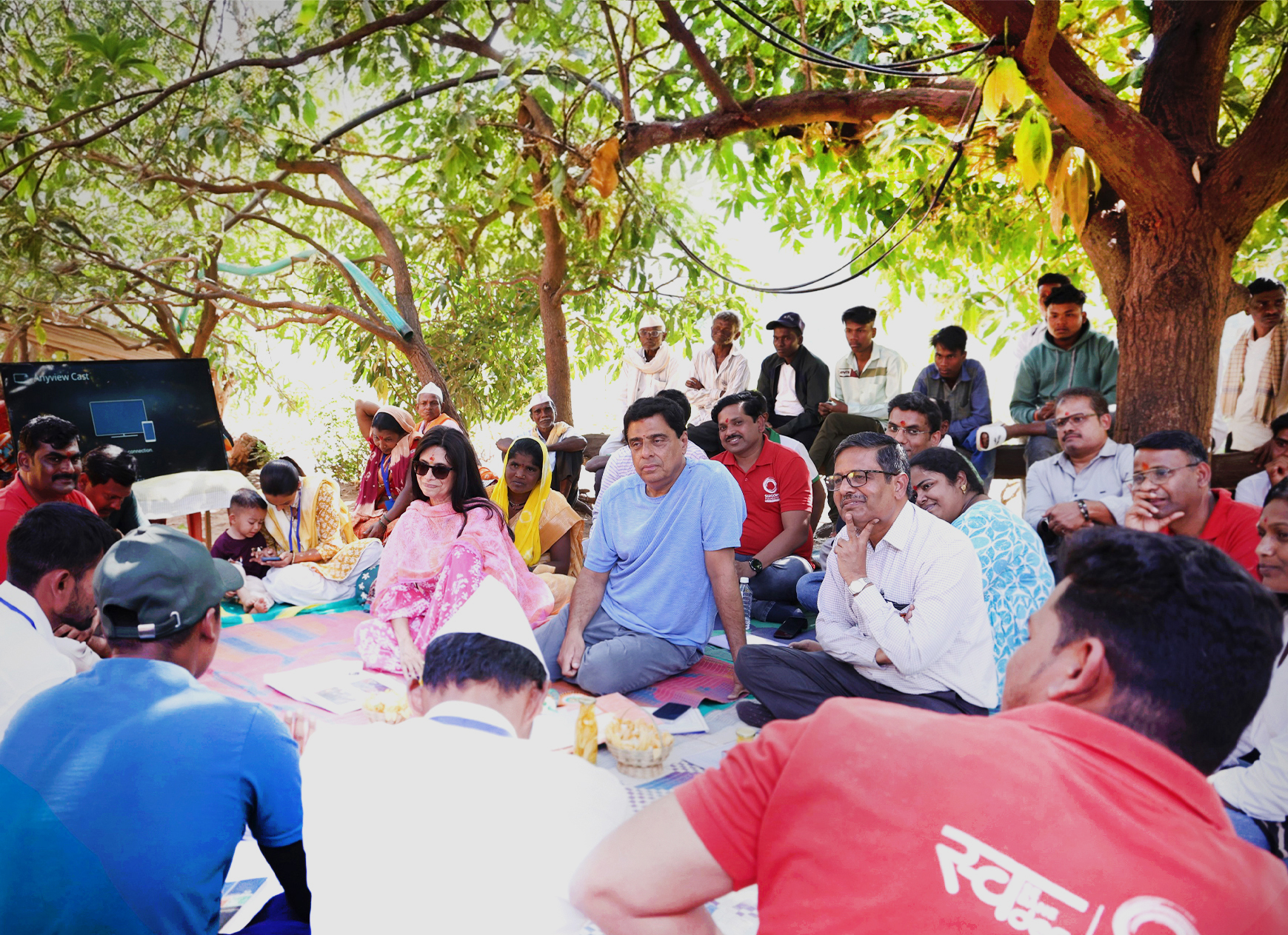
Photos (main and middle): Ronnie and Zarina Screwvala visiting some of the rural village communities in rural India that are supported by the Swades Foundation.

| Ready to invest in independent, solutions-based journalism?
Our paying members get unrestricted access to all our content, while helping to sustain our journalism. Plus, we’re an independently owned social enterprise, so joining our mission means you’re investing in the social economy. |