
Blended finance market remains resilient in 2025 despite aid cuts – Convergence report
Increase in private capital towards blended finance deals is “encouraging”, but scarcer concessional capital will have to be used “surgically” for market to truly scale, according to research published this week.
The blended finance market held steady in 2025 despite record cuts in international aid, boosted by a jump in private investment, according to a new report by global network Convergence.
Overseas development assistance, the main source of concessional capital in blended finance transactions, went down by nearly a quarter last year, following the closure of USAID and cuts by a number of high-income countries.
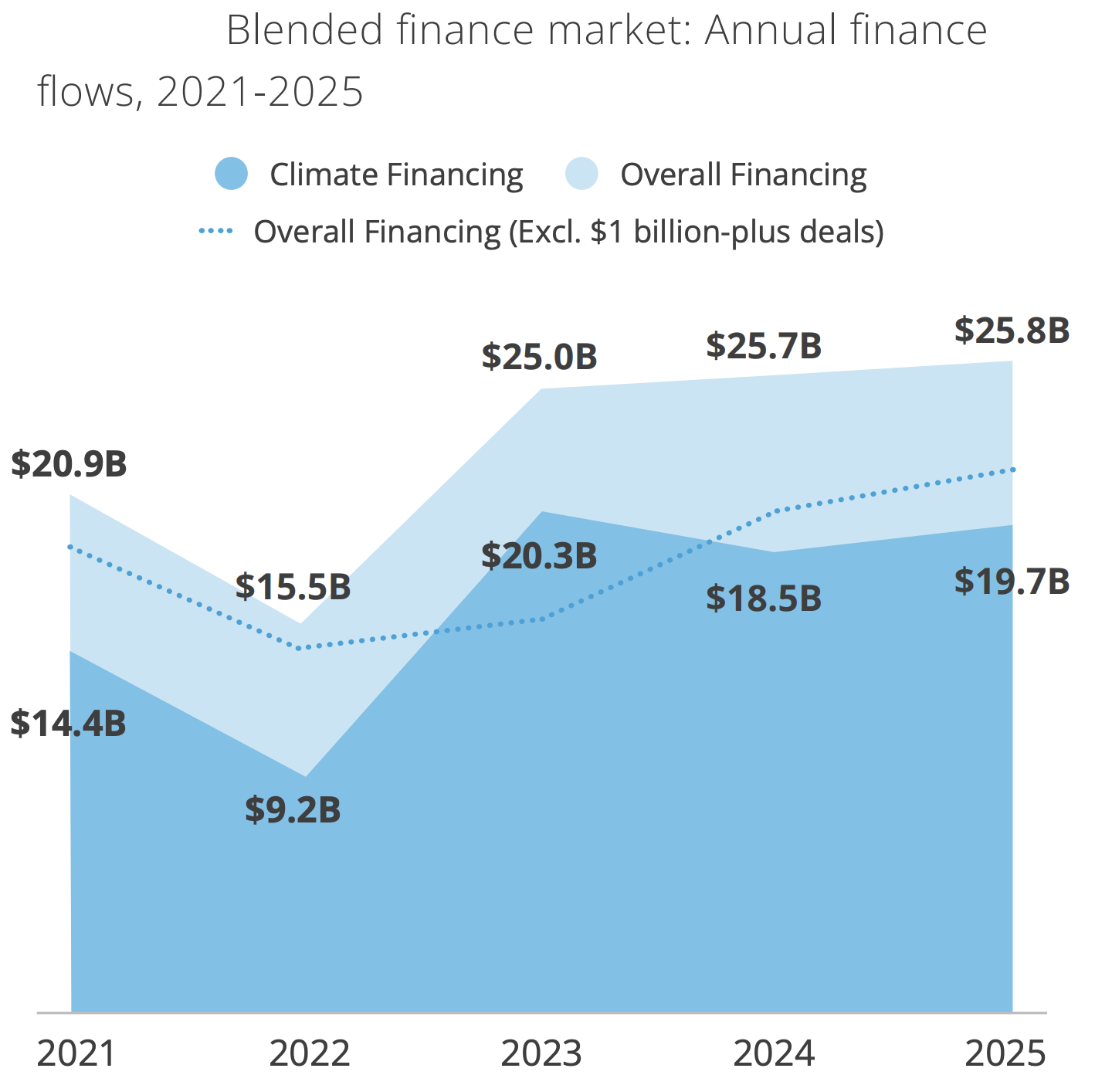
But the total volume of financing flowing towards blended finance in 2025 stood at US$25.8bn across 181 transactions, broadly stable compared with the previous year (US$25.7bn) and 2023 (US$25bn), according to the State of Blended Finance 2026 report, released yesterday.
Source: State of Blended Finance 2026
This was in part driven by a 27% rise in private sector investment in blended finance deals, from US$8.8bn in 2024 to US$11.2bn in 2025, mostly through investment from commercial banks.
 “At a time when development resources are under enormous pressure, the increase in private investment is an encouraging signal,” said Joan Larrea, CEO of Convergence (pictured). “But resilience is not the same as scale.”
Climate finance remains by far the largest share of the blended finance market, reaching US$19.7bn in 2025, a US$1.2bn increase on the year before (6%). Financing for climate adaptation in particular jumped by a record 133%, from US$2.4bn in 2024 to US$5.6bn in 2025.
“This growth is significant because adaptation has historically been very difficult to finance commercially and even through blended finance structures,” Ilsa Weinstein-Wright, senior associate on the market insights team at Convergence, said at the online launch of the report on Wednesday.
Impact of aid cuts remains limited – for now
Aid financing towards blended finance appeared relatively shielded from the unprecedented cuts that took place in 2025, with the report suggesting this may reflect donors’ prioritisation of blended finance over forms of direct aid funding (like grants) in order to achieve further impact with less money.
But this might not last. Weinstein-Wright explained that because blended finance allocations are shaped by dedicated programmes, existing pipelines and the timing of commitments, “there could be a delayed effect as current funding cycles unwind and tighter aid budgets feed through. So we would expect some of the pressure to become more visible over the next couple of years.”
- Read more: Blended finance market should brace for impact of development aid cuts – Convergence warning
The amount of aid funding directed towards blended finance is also only a small fraction of total aid disbursed globally (1% to 3% annually). But over time, “the relative protection afforded to blended finance within aid budgets may become harder to sustain”, says the report.
Also speaking at the launch, Sylvia Wisniwski, CEO of German impact fund Finance in Motion, said the scarcity of concessional capital was already translating into less blended finance capital becoming available for funds. “That reality is already there, and where we may have exceptions, actually it has become much more difficult to access it,” she said.
The relative protection afforded to blended finance within aid budgets may become harder to sustain
One particularly successful programme, Brazil’s Eco Invest, a blended finance platform aimed at mobilising foreign investment toward Brazil’s climate and ecological agenda, is also inflating the numbers: US$3bn was invested through the platform in 2025, roughly 11% of the total market size.
“Without that concentration of activity in Brazil, the headline market numbers would have looked considerably weaker,” Claudia Velimirovic, markets insights associate at Convergence, said at the launch. “This raises the question of how durable that resilience is if the broader development finance environment continues to tighten.”
The ‘most important variable’: mobilisation
The report shows that in 2025 each dollar of concessional finance worked harder to mobilise commercial capital: leverage – the amount of capital invested at market rate for each dollar of concessional capital provided, whatever the source – rose to US$5.33, up 29% from US$4.14 in 2024 and up 36% from the US$3.92 historical average. Mobilisation of private capital specifically also rose, with each concessional dollar mobilising US$2.57 in private investment.
But while these numbers are encouraging, they are nowhere near the level of leverage required to grow the market to a scale that would meet the need for blended finance globally, according to the researchers.
The report’s market forecast to 2028 shows that while growing the provision of concessional capital would help sustain current growth, it would not be enough to deliver a real step change: that would only be made possible by a substantial rise in leverage of commercial capital – reaching a ratio of 1:8 would grow the market by 83% more than under a baseline scenario where concessional capital does grow but leverage remains steady.
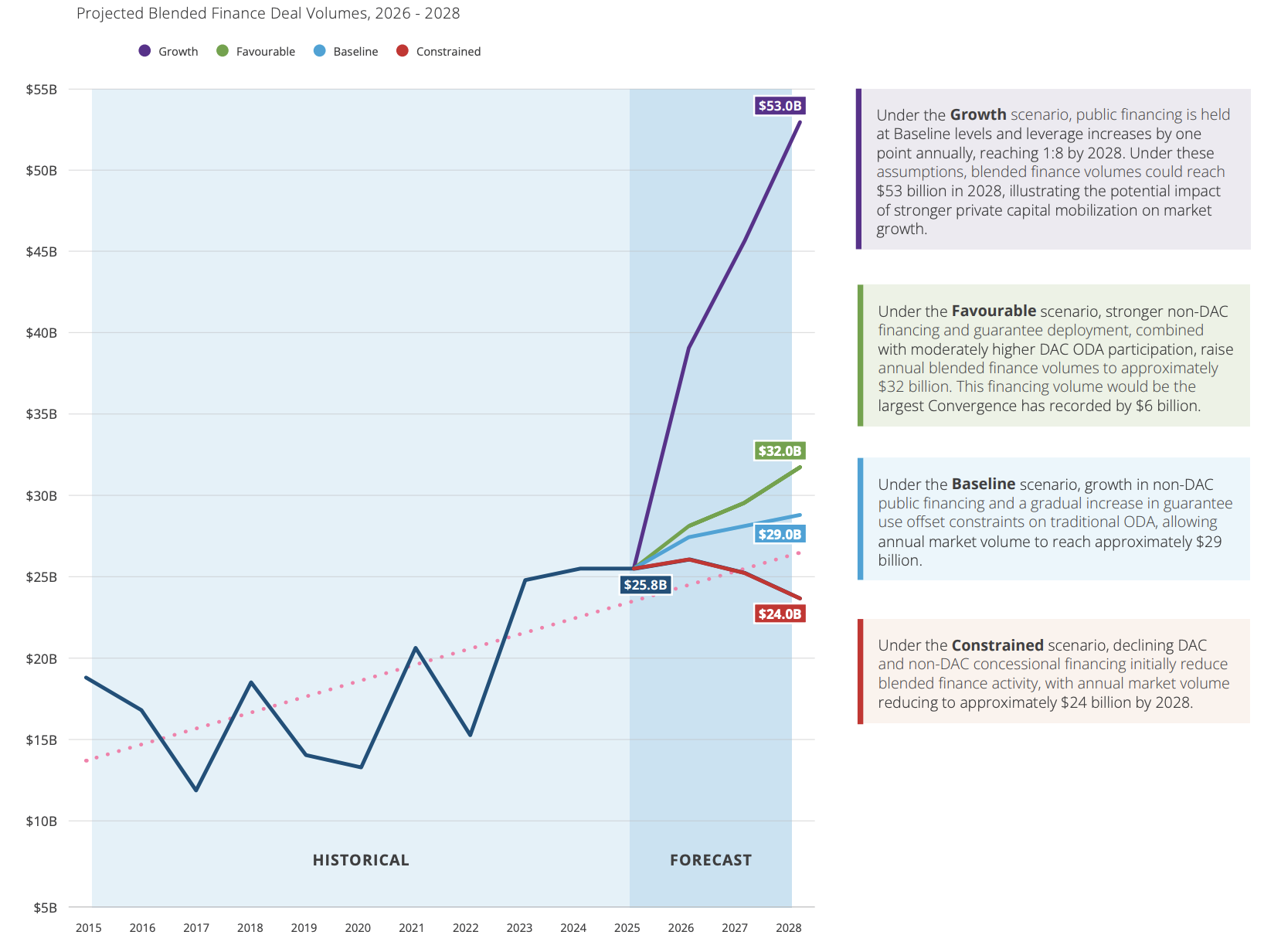
Above: Convergence researchers' forecasts show increasing private capital mobilisation would enable substantial growth of the market. Source: State of Blended Finance 2026
“The next phase of blended finance should not simply be about doing more deals,” Larrea added. “It should be about building a much more efficient and effective system for mobilising private capital at scale. The constraints facing us are real. But so is the opportunity to rethink how this market works.”
But mobilisation targets can work at odds with other impact objectives (trying to attract more private investment can lead to moving away from riskier, high-impact markets for example), Larrea points out, so the challenge will be to use concessional capital as efficiently as possible. She suggests moving towards a “surgical use of blended finance”: identifying the precise risks that hold private investors back from investing in blended finance transactions, and using concessional funding to target those.
The next phase of blended finance should not simply be about doing more deals
The report identifies four such risks (country, currency, credit and climate risk) and points to one potential solution: country platforms. Those are country-led mechanisms for coordinating policy, project development, and investment around national development and climate priorities to scale investment – through mobilising domestic resources and coordinating government and international development partners.
“Better mobilisation, and depending on your world view, better use of catalytic money by private sector actors, [is] going to be one of the most important variables for growth in the field,” Larrea said at the launch.
- Read more from Joan Larrea: Blended finance isn’t perfect, but it’s essential
Higher use of guarantees
The 2025 increase in private capital mobilisation stems from a higher use of guarantees by providers of concessional capital, notably multilateral development banks (MDBs) and development finance institutions (DFIs). Guarantees (which cover potential losses for other investors) “can enable larger volumes of commercial financing relative to concessional capital deployed by mitigating specific risks rather than directly funding a larger share of the transaction”, the report explains.
It also shows an important shift in how MDBs and DFIs engage in blended finance transactions, according to the researchers. “The report finds that while DFIs and MDBs are providing less direct financing to blended finance this past year, their overall participation actually increased because instead they provided and made greater use of guarantees and other risk-sharing instruments,” Weinstein-Wright explained.
A geographical shift
The report shows that for the first time in a decade, Sub-Saharan Africa was no longer the leading region for blended finance, with financing to the region falling 46% to US$4.6bn in 2025 compared with the year before. Eastern Europe and Central Asia became the largest region by investment volume at US$6.7bn, followed by Latin America and the Caribbean at US$5.4bn (which was in great part boosted by Brazil’s Eco Invest programme).
In a capital-constrained world, investment will flow where it meets the least resistance
Andrew Wainer, director of market insights at Convergence, said: “Private capital is generally easier to mobilise in higher-income markets with stronger enabling environments, and this year’s data underscore how persistent risk can leave lower-income countries behind.”
Larrea noted that, while the shift shouldn’t be interpreted as a “simple flight from one region to another”, it indicates that “capital is gravitating toward markets where risks can be more readily managed… In a capital-constrained world, investment will flow where it meets the least resistance.”
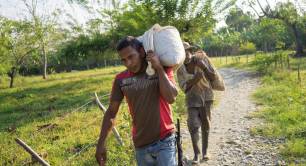
Top image: A field technician at Greenbox, a social enterprise that supports farmers in Peru to switch to organic production over illicit crops such as coca. In 2025 Greenbox received a fifth loan from the the NESsT Lirio Fund, a blended finance fund that provides flexible capital to high-impact social enterprises (credit: Greenbox).

| Ready to invest in independent, solutions-based journalism?
Our paying members get unrestricted access to all our content, while helping to sustain our journalism. Plus, we’re an independently owned social enterprise, so joining our mission means you’re investing in the social economy. |