


Impact investments worldwide hit US$1.76tn as growth slows – GIIN report
Cooler growth sign of a maturing market, according to the GIIN’s State And Size Of The Impact Investing Market 2026, while GIIN leaders suggest focus should turn to greater effectiveness.
Impact investments worldwide reached US$1.76tn across 3,000 organisations as of December 2025, as the growth of the market cooled compared with previous years, according to the latest estimate by the Global Impact Investing Network (GIIN) published today.
The GIIN’s State And Size Of The Impact Investing Market 2026 shows a 12% increase on its most recent sizing of the global impact investing market published in 2024 – when researchers valued impact assets under management globally at US$1.57tn – a substantially slower growth than between 2022 and 2024, when the market rose by 35%.
The researchers estimate the impact investing market’s compound annual growth rate (CAGR) – a measure of average annual increase over several years – dropped to 6% between 2024 and 2026, compared with 21% between 2019 and 2024.
The report suggests the slowdown is a sign of a maturing market: “Rather than signaling a retreat, this pattern may reflect a market moving from rapid early adoption into a more measured, sustained growth phase.”
|
The GIIN is a network of 450 impact investors across six continents, founded in 2009 with the mission to “increase the scale and effectiveness of impact investing around the world”. It defines impact investments as “investments with the intention to generate positive, measurable social and environmental impact alongside a financial return, and specifically use that investment capital along with engagement or investment terms to positively influence targeted impact results”. |
Concentration of capital
Alongside its market sizing exercise, which the GIIN produces every two years, the report includes an in-depth annual survey of a sample of impact investors. Among the 331 respondents to this year’s survey, two-thirds are fund managers, and 11% are foundations. Other categories include development finance institutions (DFIs) and family offices (both accounting for 4% of respondents each) and institutional asset owners (3%).
Many of the most active impact investors manage a relatively small number of assets
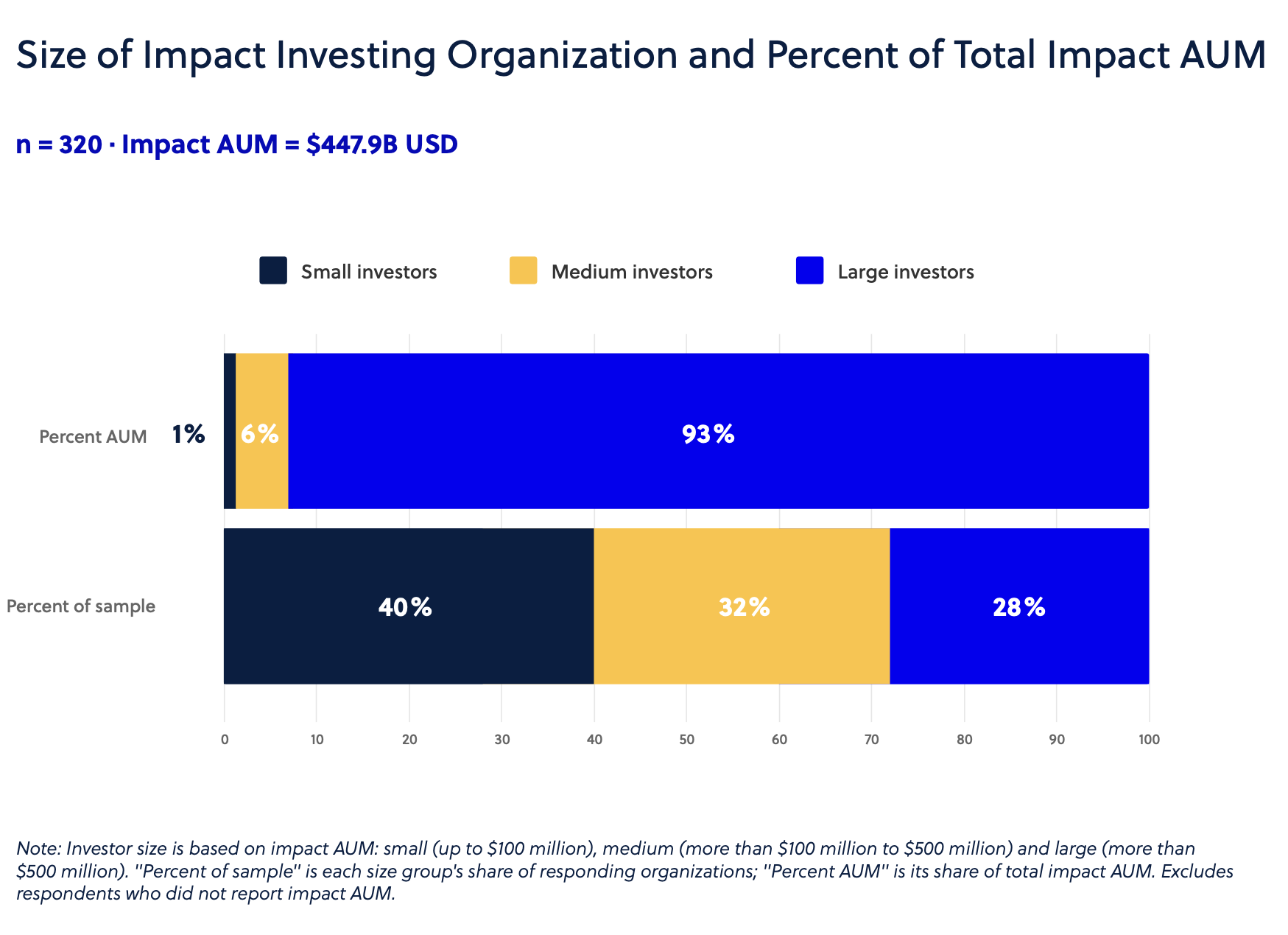
The report points to a concentration of impact assets under management in the hands of a relatively small number of large investors, reflected by a major difference in the size of the average impact portfolio (US$1.4bn) and the median (US$162m). Large impact investors (defined as managing more than US$500m in assets) represent 28% of survey respondents, but account for 93% of total impact assets under management. Among those are institutional investors, which provide 35% of impact capital globally.
Small investors (which manage less than US$100m), account for 40% of respondents, but manage just 1% of impact assets. “It is clear from our sample that many of the most active impact investors manage a relatively small number of assets,” the researchers write in the report.
Large and small investors show clear differences in how they allocate their capital, with large ones targeting more mature companies, including those publicly traded, and small investors funding businesses at early stages of their development. This is in part due to ticket sizes (mature companies require more capital) and the cost associated for each deal regardless of size, which lower the cost per dollar deployed for larger investments.
Greater effectiveness

While the market has reached a large size, the focus should now shift towards how it can become more impactful, according to GIIN’s chief operating officer Dean Hand (left, above) and director of knowledge and practice Kate Walsh (right, above). “This year’s State and Size of the Impact Investing Market report suggests that the next chapter cannot simply be about the market’s growth,” they write in the report’s foreword.
Key findings of the report – such as slower growth and concentration of capital – “point to a field moving from proving that impact investing can exist at scale toward a harder and more important challenge: turning that scale into greater effectiveness,” they argue.
Our shared opportunity now is to help turn that growth into greater effectiveness and greater relevance
This will require a “persistent effort from the ecosystem”, from mobilising capital from investors and building practically investable impact strategies to better approaches to impact measurement and management, Walsh and Hand suggest. “Our shared opportunity now is to help turn that growth into greater effectiveness and greater relevance to the challenges the world needs capital to solve,” they write.
Market-rate returns still dominate
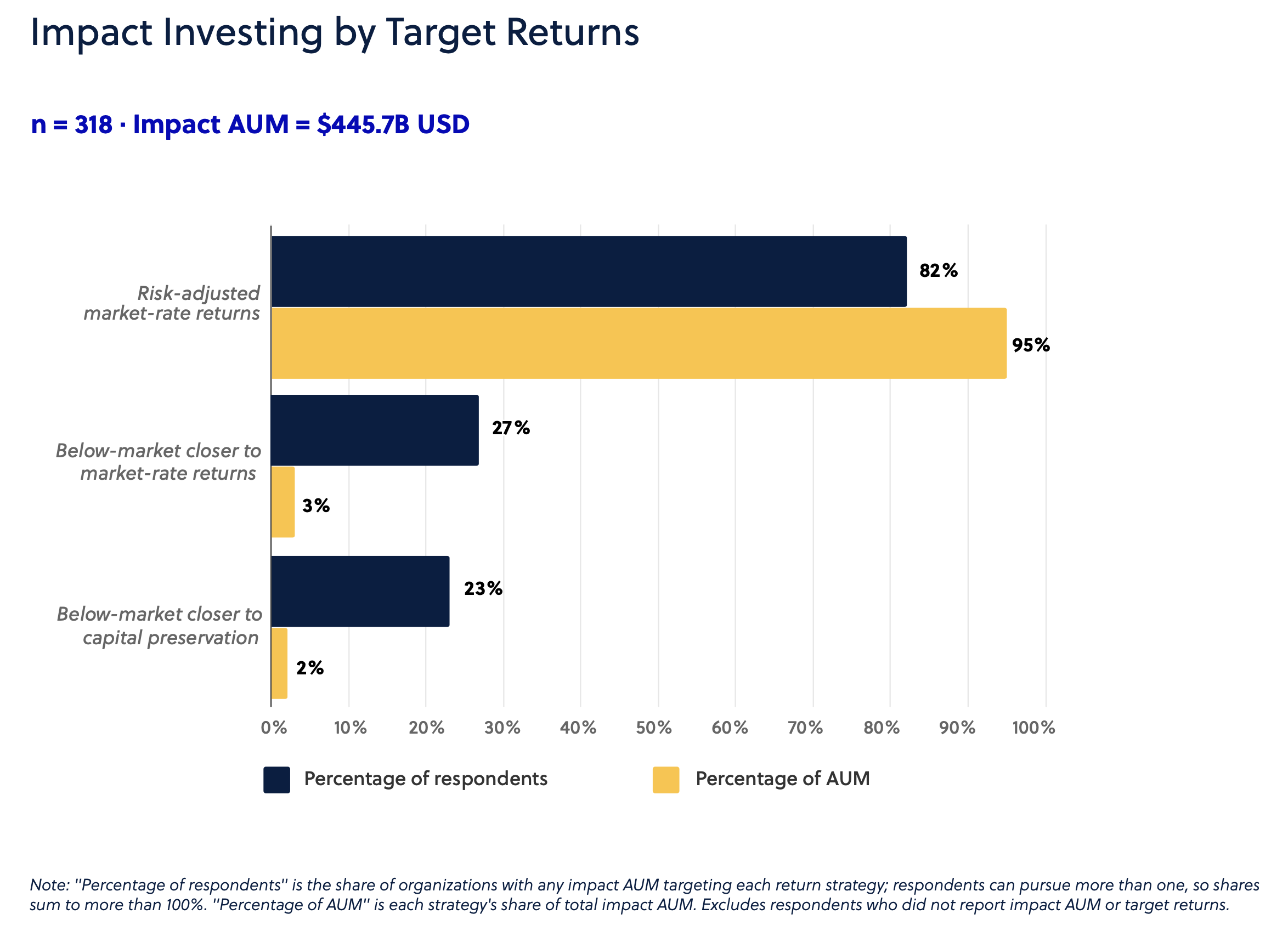
While the discussion around whether impact investors should accept below market returns to be truly impactful grows in recent years, the report shows impact investors overwhelmingly do not intend to make any concessions on returns.
The survey found that more than eight in 10 investors target risk-adjusted, market-rate returns, accounting for 95% of global impact assets under management. Many of them also allocate part of their capital to impact investments targeting below-market rate returns, albeit small: about 50% of all respondents report pursuing at least some concessionary strategy with part of their portfolio; however, concessional investments account for only 5% of total impact assets.
In this context, investor satisfaction with both financial and impact results remain high, suggesting investors consider they can achieve the impact they desire without making concessions on returns. Just over 70% say they are satisfied with the financial performance of their impact investments, while nine in 10 report satisfaction with their impact results.
Global north focus remains
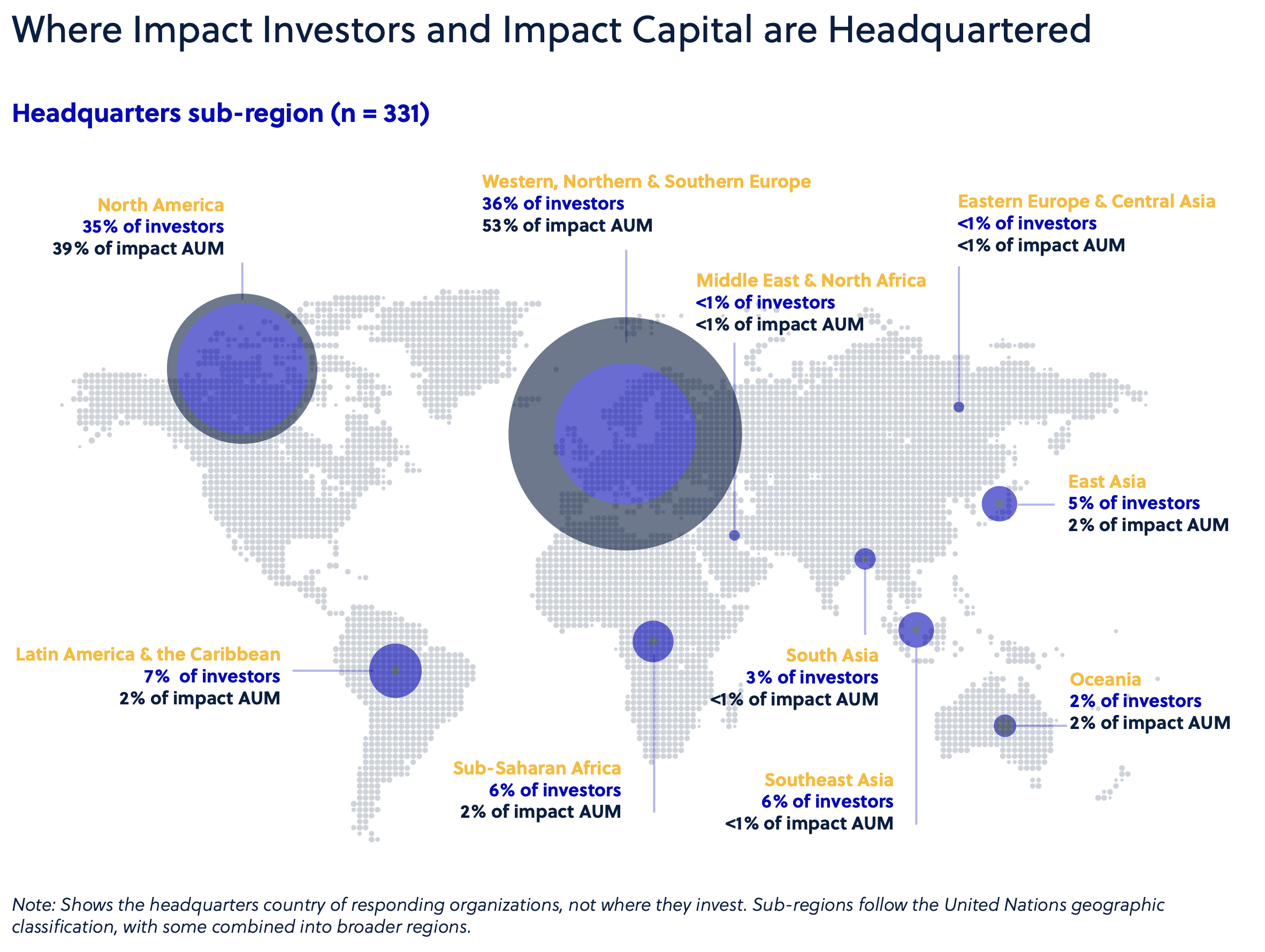
As in previous editions of the survey, this year’s data shows funds are focused on the global north – which has been flagged as a concern by many in the global south. Investors in North America and Europe account for 92% of global impact assets under management, and most impact capital is allocated to those regions (55%), with nine in 10 respondents targeting them with at least some of their impact investments.
While a large number of investors target Sub-Saharan Africa (42%) and Latin America (37%), those only attract a relatively small share of impact capital in dollar terms – 5% and 12% of the total respectively.
Leading challenges
The slower growth comes as impact investors face multiple challenges, some of which are similar to those faced by the financial markets at large and others more specific to the sector.
Like in previous years, the most common issues highlighted by survey respondents are broader economic factors: more than nine in 10 cite the economic outlook as a challenge, and inflation and interest rates are both reported as an issue by roughly eight in 10.
But issues particular to impact investing are also prevalent: 84% of respondents see costs associated with impact investing as a challenge, and 83% mention a lack of alignment between asset owners and asset managers around impact and financial objectives as an issue.
Three quarters of respondents see the politicisation of impact investing as a challenge, reflecting an increasingly polarised geopolitical landscape. A lack of clear guidance from regulators is also mentioned by 84% of respondents.
Top image: Size of the impact investing market over time. All charts and graphics: State And Size Of The Impact Investing Market 2026, Global Impact Investing Network, 2026.

| Ready to invest in independent, solutions-based journalism?
Our paying members get unrestricted access to all our content, while helping to sustain our journalism. Plus, we’re an independently owned social enterprise, so joining our mission means you’re investing in the social economy. |