Collection: Good Experts



A deep dive into AI for impact, without harming people or planet: this week's view from the Pioneers Post newsroom.
The steady stream of bad news about AI is hard to miss. Perhaps you saw the recent story that instructions from an AI agent at Meta caused a large leak of sensitive user and company data?
Maybe you read reports that big tech firms were sacking hundreds of employees, giving the explanation that developments in AI mean they can do more with fewer people. Or the furore around horror novel Shy Girl being discontinued by its publisher after allegations the author relied heavily on AI.
Whether it was one of these or something else that piqued your interest, it can be difficult to avoid the perception that we’re witnessing an under-regulated and poorly understood technology, underpinned by Silicon Valley’s extractive capitalism values, run amok.
We know there are many social entrepreneurs out there who can see the potential for AI to maximise their impact, but feel paralysed in their ability to do so, either because they are concerned about the ethics of the technology or they lack the technical or financial capacity.
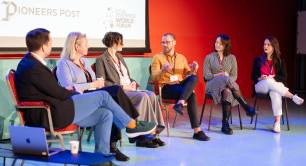
Which is exactly why we made our film The AI Dilemma with James Gauci, founder of social enterprise and ethical AI consultancy Cadent. In the film we explored cutting edge tech for impact ideas with leading social entrepreneurs, and dived into the ethical conundrums of AI with global experts.
The material we gathered, from hours of interviews with experts, was so rich with insights and inspiration we couldn’t fit it all into the film. So now we’re publishing some of the interviews in full as podcasts.
This week we published James’ conversation with Nikoline Arns, a civic tech entrepreneur who has been building and challenging new technologies for almost a decade. Arns is a champion of open source technology and small scale, lightweight AI models – specific tools to do specific jobs.
Arns believes social enterprises have a responsibility to properly understand the technology, and companies behind that technology, that they want to use. “I feel like there is a big gap of understanding. People know that AI is a solution, but they have no idea how it works. Who are the companies behind it? If you are already building your business in a conscious way, you should look at the technology in the same conscious way,” she says.

We’ve also published James’ interview with Taiwan’s cyber ambassador-at-large Audrey Tang, who was named by TIME Magazine as one of the most influential people in AI.
From “techno-communitarianism” to “polarisation per minute” to “ancestral intelligence”, Gauci and Tang uncover ways AI can be developed and used while maintaining a commitment to serving people and planet.
Tang summarised her philosophy on AI by sharing a prayer:
“When we see an internet of things, let’s make it an internet of beings.
When we see virtual reality, let’s make it a shared reality.
When we see machine learning, let’s make it collaborative learning.
When we see user experience, let’s make it about human experience
And whenever we hear that the singularity is near, let’s always remember the plurality is here.”
As Arns and Tang articulated, there are ways to make use of AI for impact without having to rely on tools and technology built by companies not aligned with the values of social enterprise.
If you’re seeking further inspiration and real world examples of how AI can shape positive change in sectors ranging from climate and food to education, health and security, take a look at the finalists in this year’s She Shapes AI global awards. Check the event website for details of the She Shapes AI Conference and Global Awards Ceremony, taking place on Thursday 16 April in London, UK, and online.
We’ll continue to highlight examples of pioneering social enterprise tech innovations – if you’ve got an AI story to share, please get in touch.
How to use AI without harming people and planet, with Nikoline Arns and James Gauci
The AI dilemma: Can social enterprises innovate without compromising their values?
The Impact World this Week: 9 April 2026
Top image: Audrey Tang (credit: An Rong Xu, Flickr)

| Ready to invest in independent, solutions-based journalism?
Our paying members get unrestricted access to all our content, while helping to sustain our journalism. Plus, we’re an independently owned social enterprise, so joining our mission means you’re investing in the social economy. |