

My quest to give every baby a chance to survive and thrive in rural Uganda
 Following the devastating loss of her cousin’s premature baby in rural Uganda where medical facilities are few and far between, Comfort Ayikoru – a medical student at the time – created a solution to the country’s desperate lack of incubators. Her innovation was a battery-powered baby carrier which monitors babies’ vital signs, sending data to doctors and advice to mothers. She shares the journey of her medtech social enterprise BuriCare from start-up to award-winner.
In 2020, my family faced the tragic loss of my cousin’s preterm baby. She died in our arms, as we urgently made our way to a regional hospital in search of an incubator. She was one of the many premature babies born in Uganda to suffer this fate.
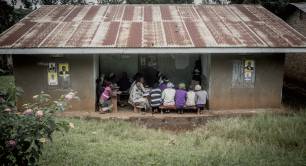
As is the case for many others, a lack of resources let us down. Across the country, only about 51% of the population has electricity and just 24% of our healthcare facilities offer basic services.
A nationwide challenge
Lack of adequate support for mothers and babies starts long before birth. Many miss out on care during pregnancy, and babies are often born critically ill. Approximately 14% of all births are preterm, with the majority of these requiring incubators.
This issue is particularly acute in rural communities, where 19.4% of the population lives in poverty (vs. 10.3% in urban areas). I am from Arua – a small village in the northwestern part of the country – and just three incubators serve our entire region.
This lack of access to sufficient resources compounds the difficulties that new parents face, and I have personally seen the helplessness felt when caring for fragile newborns without reliable tools.
A locally-rooted solution
I was a medical student at the time that my cousin’s baby died, but was living at home owing to the pandemic. When I returned to university, I made a promise to myself: I will not sit here and watch preventable deaths continue to happen.
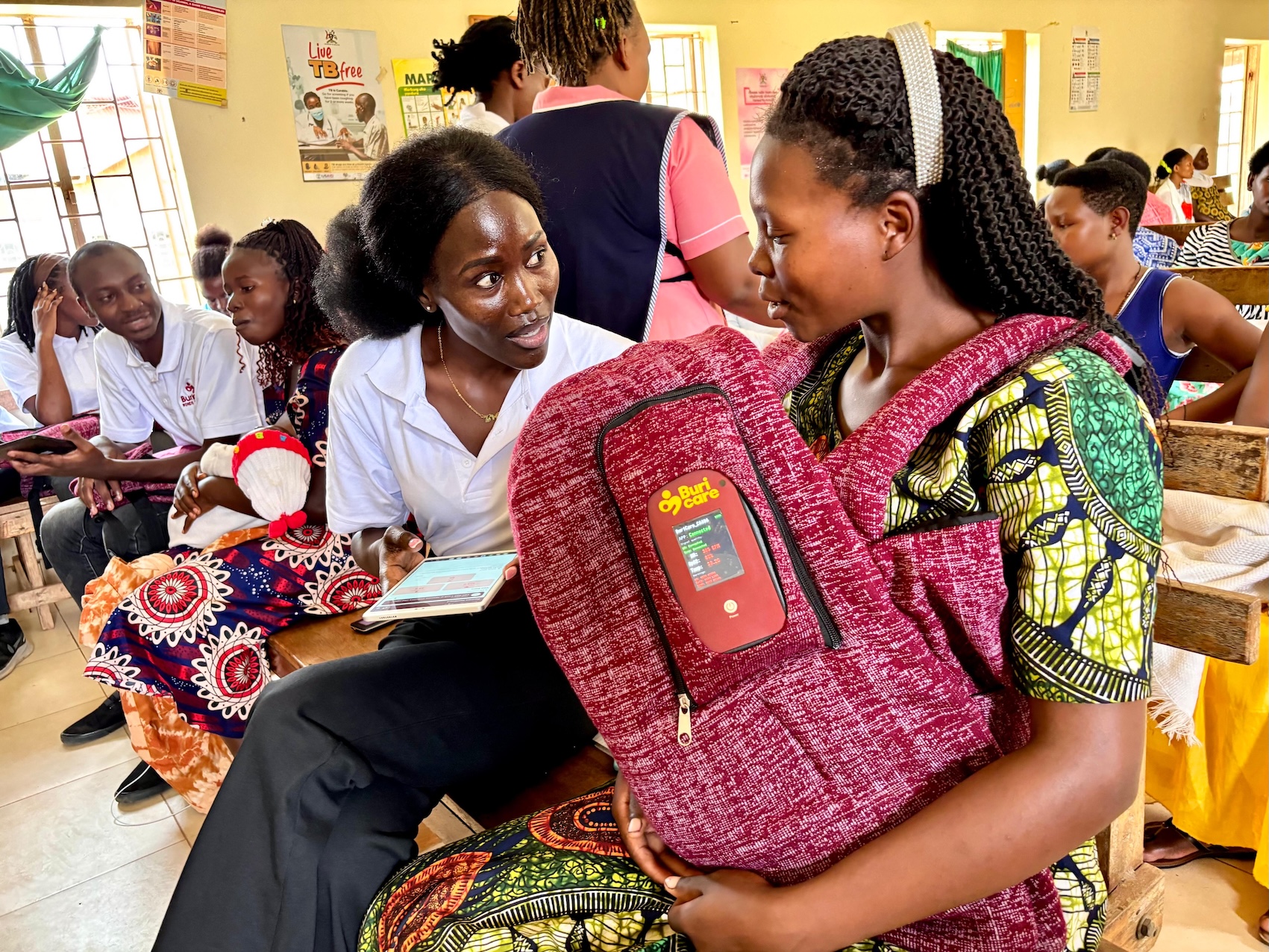
As a doctor, I was in the fortunate position to make a change. And so I began to work to develop a solution, ultimately landing on the idea of a tech-enabled baby carrier that is designed to improve the wellbeing of underserved mothers and their babies (pictured below).
Mimicking ‘kangaroo care’ – where newborn babies are held directly against a parent’s chest – these carriers provide continuous skin-to-skin contact and warmth, providing many of the benefits that incubators offer, while encouraging parent-baby bonding.
The issue is not that mothers are dependent on others – it’s that they lack the tools to support both themselves and their children
To meet the challenge of regular power outages – a reality in such settings – the carriers are battery-powered, lasting several days before needing to be recharged.
The carrier monitors a baby’s body temperature, pulse rate and oxygen level, transmitting data to an app that enables remote monitoring by health professionals. This reduces the burden of frequent hospital visits and ensures medical attention from afar.
The app, which can also be accessed by the mothers, also delivers healthcare tips in local languages, empowering mothers to sufficiently care for themselves and their babies. The issue is not that mothers are dependent on others – it’s that they lack the tools to support both themselves and their children. By bridging this gap, we are supporting communities to become more resilient, because when parents thrive, young children flourish and societies prosper.
Nothing travels in a straight line
This has not been a straightforward journey. How do you convert an idea into reality, when you too have limited access to funding and guidance?
To begin with, we started fundraising among ourselves at university, and applying for grants and various innovation programmes. We had limited success at first, but secured enough funding to get us started – thanks to a programme run by TotalEnergies – and to set up BuriCare Baby Carrier Limited.
There were various other hurdles.
Uganda does not have any ISO-certified manufacturing companies, so we had to look further afield. Unsurprisingly, very few manufacturers were interested in such a small-scale project. We met many dead ends until finally coming across a Kenyan-based organisation called Gearbox, who have been helping us since.
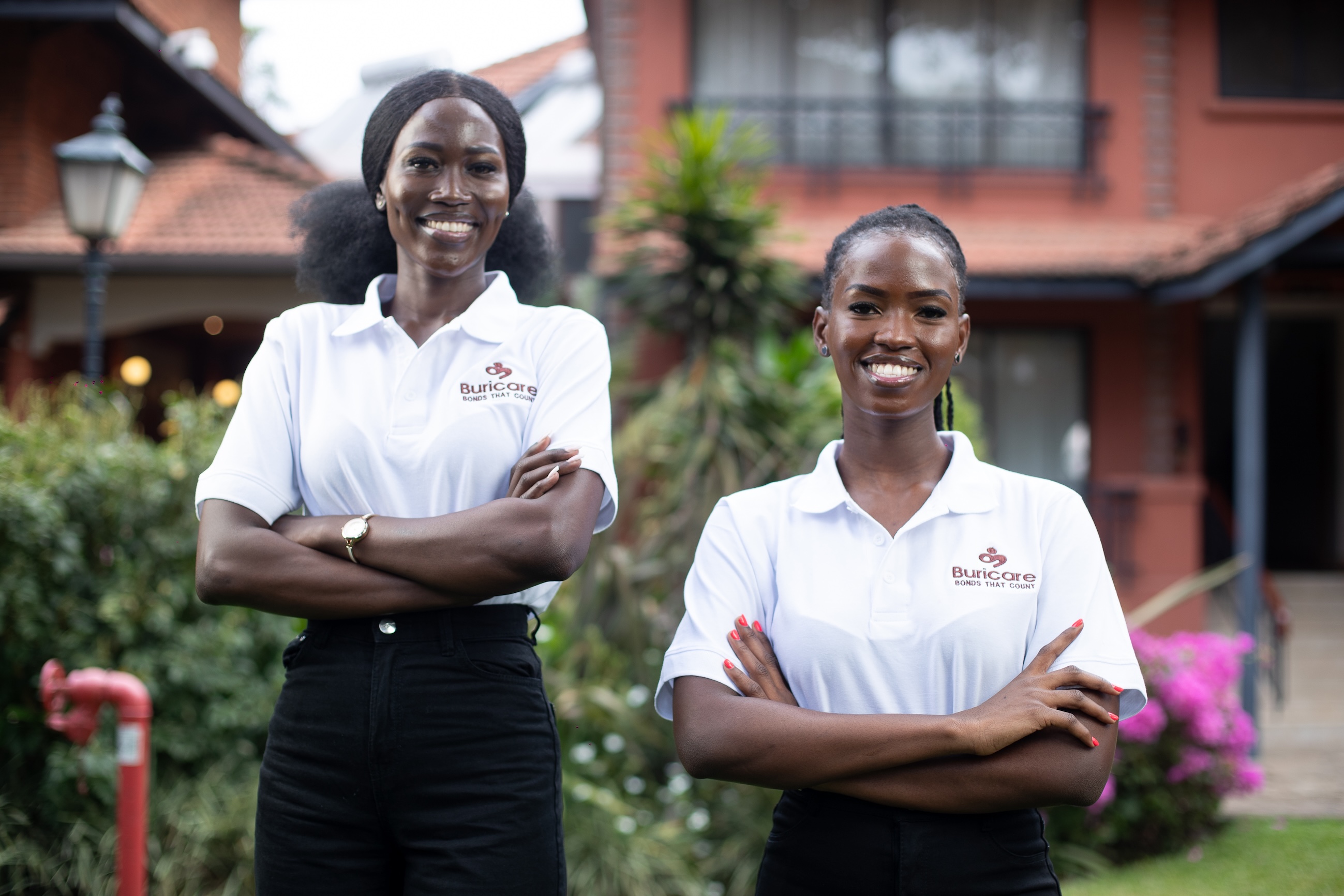
‘We’re a team of clinicians, engineers and researchers brought together by what we’ve seen first hand: parents caring for fragile newborns while feeling scared, alone, and unsure’: BuriCare co-founders Comfort (left) and Bridget Prudence Nakato
We also faced huge challenges with meeting regulatory standards, which further delayed our progress.
Despite everything, we have been able to develop a working prototype with support from incubator and impact investor Villgro Africa and medical innovation support network CAMTech Uganda. The carrier has been tested in studies among over 85 mothers and 38 healthcare workers – and the feedback has been incredibly touching.
Where next?
Today, we are working on the next stage of development – which has been made possible through the funding provided by the Good Start Challenge: a challenge prize focused on advancing solutions that support the wellbeing of parents of young children, initiated by the Van Leer Foundation; supported by FEMSA Foundation, Fundaçāo Maria Cecilia Souto Vidigal, and LEGO Foundation; and run by Challenge Works (part of Nesta).
As a finalist in the prize, we have received €50,000. We feel incredibly lucky; this is a sum of money that we didn’t think possible.
The dream is to win the prize, so that we would be awarded another €200,000 and linked with key development partners to help us scale. We will find out later this year, but until then we are laser-focused on improving the carrier and its digital platform, in the hope that we can reach as many in need as possible.

| Ready to invest in independent, solutions-based journalism?
Our paying members get unrestricted access to all our content, while helping to sustain our journalism. Plus, we’re an independently owned social enterprise, so joining our mission means you’re investing in the social economy. |