


Asia's impact network tells its own billionaires to step up
In Delhi for the first time, Asia's largest philanthropy and impact investment network, AVPN, says despite the region's 1,000+ billionaires, its biggest challenge is the lack of Asian money.
NEW DELHI — For the first time in its 13-year history, AVPN, the largest network of philanthropists and impact investors operating in Asia, opened its annual global conference on Indian soil on Tuesday. Its leaders used the occasion to press a blunt argument on their own membership. Asia now has more than 1,000 billionaires, and still relies on money from outside the region for 60% of the development financing spent inside it.
“The biggest challenge that AVPN is trying to actually address is the lack of Asian money,” Naina Subberwal Batra (main photo above), the organisation's CEO told reporters at a briefing ahead of the conference's opening session at Bharat Mandapam, the convention centre that hosted the G20 summit in 2023. “How do we actually change that? It's really looking at building and creating an ecosystem where Asian wealth holders really see themselves as the prime drivers of change.”
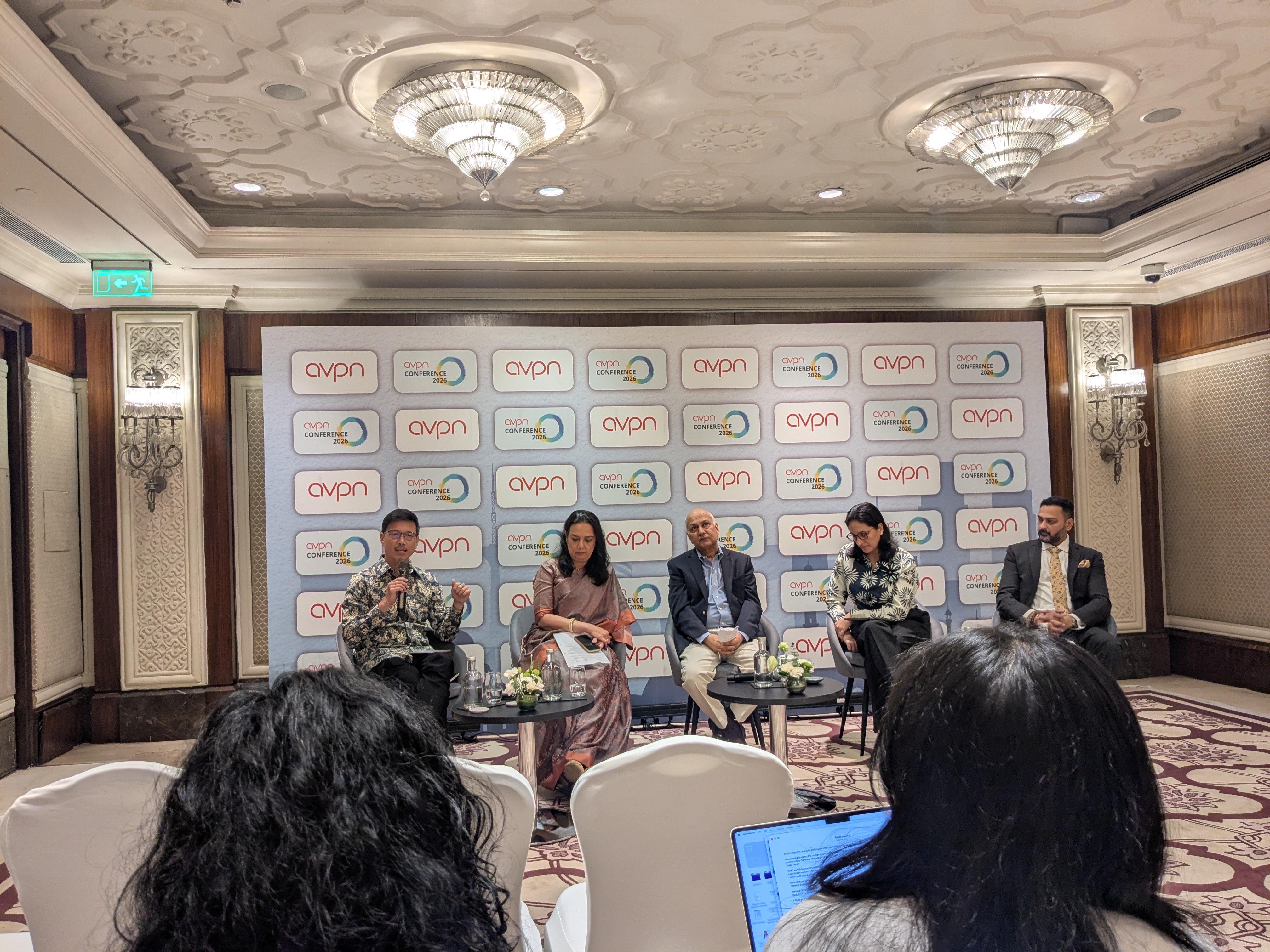
The AVPN Global Conference 2026, built around the theme ‘A Blueprint for Action in Asia’, expects close to 2,000 delegates from more than 40 countries over three days, according to a conference press release. It is the organisation's 15th year and its 13th global conference, but the first held in India, a choice AVPN's chair, Achal Agarwal, framed as a statement in itself.
Record corporate responsibility spend
“India has a growing role in Asia's impact story, and is no longer simply a destination for impact capital,” Agarwal said in the same briefing. “It is fast becoming a source of ideas, innovation and solutions that will shape Asia's future.” He pointed to India's mandated corporate social responsibility law, under which Indian companies spent a record 40,794 crore rupees, about $4.6bn, in the last fiscal year – up 17% from the year before, as evidence of what he called a scalable model. “If it can work in India,” he said, “then we feel that it can be scaled across Asia.”
India ... is no longer simply a destination for impact capital – Achal Agarwal
That argument came with a concrete example attached.
The government of the western Indian state of Maharashtra and AVPN used the opening day to unveil a $1bn climate investment pipeline spanning clean transport, industrial decarbonisation, renewable energy and climate-smart agriculture, along with the programme's first completed transaction: a freight electrification deal on the Jawarharlal Nehru Port Authority (JNPA) port corridor near India's financial capital of Mumbai. Organisers said they are now designing a catalytic fund to pull in private capital behind it.
Subberwal Batra ticked through a run of other announcements from the stage.
The first cohort of grantees, all from Southeast Asia, under AVPN's Harmony in Diversity Fund; a new climate-and-health financing platform called Nexa Lighthouse built with Bayer Foundation, India Health Fund and Grand Challenges Canada; the formal launch of an ASEAN CSR Working Group; and a new alliance with the Indian government, philanthropic funders and local partners called the Global Alliance for Viksit Purvodaya, aimed at strengthening education and health systems across five of India's poorer eastern states for more than 70 million people.
AVPN also said it was starting a diaspora-giving programme with the Gates Foundation, targeting Indian communities in Singapore and the United States, and a new annual research study meant to track, in Subberwal Batra's words, whether capital, knowledge and talent are “flowing to where they are most needed in a coordinated way, instead of in silos”, an idea Roshini Prakash, AVPN's chief knowledge and policy officer, said would anchor a yearly report on the “maturity” of Asia's impact ecosystem.
Bigger cheques, fewer bets
Ramkumar Venkatramani, the AVPN director who runs its investment vertical, offered the sharpest version of the conference's underlying claim. Impact investors in India deployed about $5.2bn last year into roughly 250 enterprises, he said, up from $5bn spread across some 500 enterprises the year before – evidence, he argued, that Indian impact capital is now writing bigger cheques into fewer, more scalable bets.
The future of impact investing is not going to be just imported. It's going to be designed here, executed here, and then shared with the rest of the world – Ramkumar Venkatramani
As an example of how small amounts of philanthropic money can pull in much larger sums of commercial capital, he cited a partnership between the nonprofit Villgro and the 360 ONE Foundation that used roughly $300,000 in catalytic capital to unlock about $2.5m in commercial debt for climate-focused startups, a multiple he called no longer theoretical but proven. “Asia is now building infrastructure and architecture for its own markets,” Venkatramani said. “The future of impact investing is not going to be just imported. It's going to be designed here, executed here, and then shared with the rest of the world.”
It's not a question of where's the money... The money is all around us. The question is how do we engage that money – Kevin Teo
Kevin Teo, who leads AVPN's ImpactCollab platform, described a similar bet aimed at individual wealth rather than institutions. The platform, built with Singapore's central bank and the Gates Foundation, is meant to connect more than 300,000 millionaires and 2,000 family offices in Singapore, which Teo said collectively hold about $1.2tn in capital, with more than 970 vetted nonprofits. “It's not a question of where's the money,” he said. “The money is all around us. The question is how do we engage that money.”
The briefing's most pointed exchanges came during questions from reporters.
Asked whether Asian donors and investors still tend to assume that Western philanthropy is simply better equipped to drive change, Subberwal Batra did not dispute the premise entirely. Giving as a share of wealth remains lower in Asia than in Europe and the United States, she said, citing figures of roughly 1.6% against 2.6%. But she argued official statistics miss most of what Asians actually give. Informal donations and financial help to household staff, friends and neighbours, zakat payments in Muslim-majority countries and temple and church offerings that do not get captured the way institutional philanthropy is. “A lot of Western philanthropy is motivated by tax considerations,” she said. “In Asia, a lot of philanthropy is motivated by values.”
A lot of Western philanthropy is motivated by tax considerations...
In Asia, a lot of philanthropy is motivated by values – Naina Subberwal Batra
The Trump factor
On being asked what the conference's ‘Asia for Asia’ framing meant in light of the Trump administration's dismantling of the US Agency for International Development and pressure on diversity, equity and inclusion funding more broadly, Subberwal Batra said the fallout from USAID's collapse had landed mostly on large international organisations and consulting firms that depended on that money, not on local groups, which never had access to it in the first place. She recalled an AVPN member, an executive at a large corporate foundation's Asia office, being told by headquarters in New York to direct funding towards Black Lives Matter causes. “How am I going to fund Black Lives in Asia?” the executive had asked her. “Sitting in New York, it's very easy to say that Black Lives Matter,” Subberwal Batra said. “But how much are they mattering in Asia?”
Whether Asia's own wealth will close the gap AVPN has spent the day describing is, by Subberwal Batra's own account, still an open question.
Outside of city-states like Singapore, Hong Kong and Dubai, she said, most Asian philanthropy still stays close to home, constrained by need, distrust of government, and habits of privacy around giving that predate the network trying to change them. “There is so much debate and so much talk about the rising wealth,” she said. “But in terms of really looking at spending for development, it's not really something that is considered to be a social imperative.”
The conference runs through Thursday, closing with a dedicated Impact Investing Day.

| Ready to invest in independent, solutions-based journalism?
Our paying members get unrestricted access to all our content, while helping to sustain our journalism. Plus, we’re an independently owned social enterprise, so joining our mission means you’re investing in the social economy. |