
'How do we make these unbankable climate solutions bankable?'
Five years after India and China forced COP26 to soften “phase out” to “phase down” on coal, climate change researchers and activists tell Pioneers Post at the AVPN Global Conference that the fight has quietly moved to adaptation money – and the storms battering Asia's coastlines aren't waiting for it to be settled.
Super Typhoon Ragasa tore across northern Luzon, Taiwan, Hong Kong, and China’s Guangdong province in September 2025, killing at least 25 people and dragging a wall of rain behind it. A study by the research network ClimaMeter later found the storm was carrying roughly 10% more rainfall and about 4% stronger winds than a comparable cyclone would have a few decades ago, and that sea-surface temperatures feeding it were made 10 to 40 times more likely by human-driven warming, according to Climate Central. A year earlier, the Philippines had absorbed six tropical storms in less than a month, three of them major typhoons, a clustering that World Weather Attribution called unprecedented and linked to a climate in which the country's waters can now spin up storms about seven times more easily than before industrialisation.
Those images of flattened fishing villages in the Bicol region, flights grounded across the Pearl River Delta and entire blocks of Manila underwater have run on television screens in Hong Kong, Mumbai and Bangkok often enough to indicate that something has changed for the worse.
It is no longer possible in much of Asia to talk about growth without talking about the weather that keeps interrupting it.
“Slowly, people are becoming more aware of climate change impacts,” Architesh Panda, a research fellow with the Inclusive Climate Finance for Vulnerable Communities in the Asia-Pacific project, or ICCAP, at the Stockholm Environment Institute, said in an interview with Pioneers Post. “Even in rural places in developing countries, people are dealing with climate change in their everyday lives now.”
That growing awareness is arriving five years after India and China, the world's two largest coal consumers, forced a late change to the language of the Glasgow Climate Pact at COP26, replacing a commitment to “phase out” coal with a promise to “phase down” instead.
India's chief negotiator at the time, Bhupender Yadav, defended the switch in blunt terms. “How can anyone expect that developing countries can make promises about phasing out coal and fossil fuel subsidies? Developing countries have still to deal with their development agendas and poverty eradication,” he said, in remarks reported by Scientific American. Alok Sharma, the British politician who presided over the summit, was visibly furious, telling reporters that “in the case of China and India, they will have to explain to climate-vulnerable countries why they did what they did.”
Who will bell the cat?
That argument has not gone away.
Nations still pulling people out of poverty, the reasoning goes, shouldn't be held to the same standard as countries that industrialised on cheap coal a century earlier. It has simply moved from the fight over emissions cuts to a quieter, less-covered fight over adaptation money. Who pays to armour Dhaka's flood defences, retrofit Bhutanese mountain villages against glacial floods, or make a smallholder farmer's insurance policy actually pay out when the monsoon stops behaving.
“If you look at the climate financing pattern from the last decade or two, most of the funds have gone to the mitigation side, and there is less funding coming toward adaptation solutions for vulnerable rural communities,” Panda said. “Without climate finance, most government initiatives will be far less effective.”
The numbers back him up.
Developing countries need $310bn to $365bn a year through to 2035 to adapt to a warmer planet, according to the United Nations Environment Program's Adaptation Gap Report released in 2025. They received about $26bn in 2023, roughly a twelfth to a fourteenth of what's needed.
A 2021 pledge to double adaptation finance to $40bn a year by 2025 is also falling short, the report found, because that funding has been growing at 7% annually when 12% is required. Even the $300bn climate-finance goal agreed at COP29 in Baku, which covers mitigation and adaptation combined and isn't adjusted for inflation, is unlikely to close the gap.
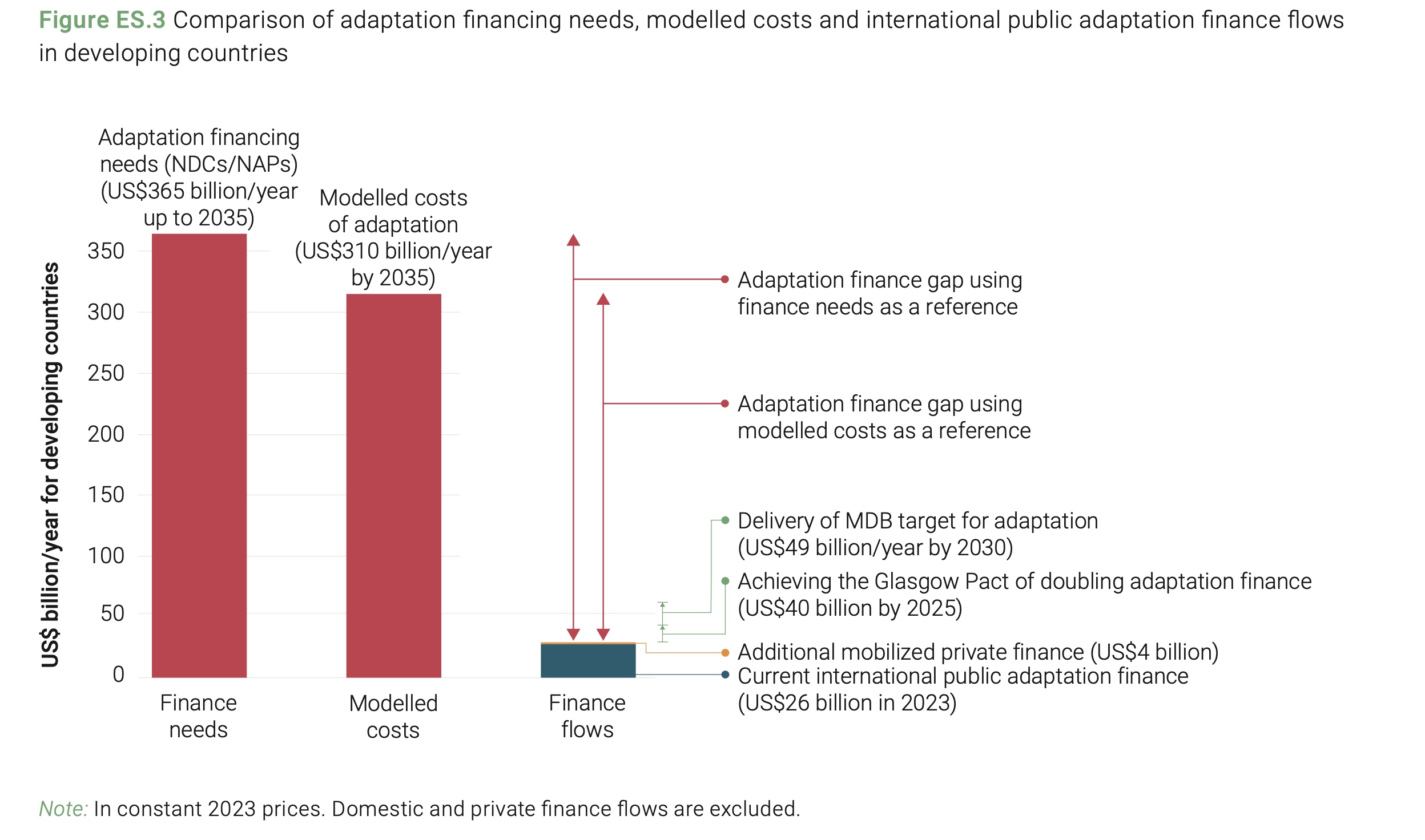
Annual adaptation finance need ($310–365bn) versus adaptation finance delivered in 2023 ($26bn), per UNEP's Adaptation Gap Report 2025
Part of the problem, Panda said, is structural rather than a shortage of goodwill.
Adaptation projects, such as a mangrove buffer, a drought-resistant seed program or a community-run early-warning system, rarely produce the kind of predictable cash flow that pension funds and private investors look for.
“Most adaptation solutions are not bankable, they're not investable,” he said. “How do we make these unbankable climate solutions bankable? How do we build investment pipelines that benefit both the people and the organisations investing the money?,” he added.
Most adaptation solutions are not bankable, they're not investable... How do we build investment pipelines that benefit both the people and the organisations investing the money? – Architesh Panda
ICCAP, which is funded by Germany's International Climate Initiative and runs through 2029, is trying to answer that question directly. It aims to train financial institutions in Bangladesh, Bhutan and four other Asia-Pacific countries and to help mobilise €250m for adaptation projects reaching some 14,000 people, half of them women, Indigenous people or the rural poor, according to the Stockholm Environment Institute, an international non-profit research institute that tackles climate, environment and sustainable development challenges.
Panda argued that the old boundary between economic development and climate resilience barely exists anymore.
Front and centre
That was evident on Day 1 of the AVPN Global Conference 2026 that brought more than 2,000 delegates from more than 40 countries to India in the organisation’s first such event in the country in the 13th year of the global conference.
As delegates made their way through the Diplomatic Enclave of New Delhi, itself a super sanitised, almost surreal version of India unimaginable to most of Indians, they encountered flooded streets after only an hour of moderate to heavy rain (main photo, above). And this part of India is home to some of the most influential people in India.
That, Panda described as evidence that growth and climate exposure can no longer be treated as separate. He also pushed back on the idea, common in boardrooms, that sustainability and profit sit on opposite sides of a scale.
“Profit doesn't have to be unsustainable,” he said. “Profit can come from sustainable investment and sustainable development. But we need to be more innovative in how we build our business strategies.”
Profit can come from sustainable investment and sustainable development. But we need to be more innovative...
He pointed to what he calls a coming period of “climate overshoot”.
Calendar-year 2024 was the first on record to average more than 1.5 degrees Celsius above pre-industrial levels, according to the World Meteorological Organization and the EU's Copernicus climate service, a single-year milestone that is not the same as a formal, multi-decade breach of the Paris Agreement's long-term goal, but one that Panda treats as a warning that the world is heading into a period where global temperatures overshoot that threshold before, in the scenario he described, eventually coming back down.
Managing that overshoot, not preventing it, is now the pertinent question, he told Pioneers Post.
Divya Sharma, executive director for India at the Climate Group and a specialist in climate resilience and urban planning with nearly two decades of experience in the country, framed the same problem from the ground up rather than the finance desk, in her own interview with Pioneers Post.
“Climate impacts are right at our doorsteps, and we cannot ignore the fact that development and climate considerations have to go hand in hand now,” she said. Every rupee spent on infrastructure that isn't built to withstand climate shocks, she argued, is a rupee that will eventually be spent twice. “Ten steps taken forward toward so-called development can bring us 15 steps back if one catastrophe comes,” she said, adding that the damage from slow-moving impacts, including degraded soil, erratic growing seasons, heat stress on outdoor workers and malnutrition, is harder to see than a flood but no less real.
A 2025 study cited in a recent analysis of India and China's climate posture found that nearly 57 percent of Indian districts now face extreme heat risk, and Himalayan glacier melt threatens water supplies for more than 2bn people across the wider region, according to the same review, published in the Journal of World Affairs by the researcher Shreya Sinha.
Sharma reserved her sharpest words for the argument, common among industrialists and officials in India, Latin America and elsewhere, that climate commitments will slow a country's attempt to “catch up with the West”.
“The biggest folly in that premise is that you are trying to catch up with the West,” she said. “What we have ignored for years is that the solutions to development are indigenous, in our local traditional knowledge.”
Nature-based approaches, the kind of water management, agroforestry and flood-plain design that predate industrial development, aren't a consolation prize for poorer countries, she argued, but a genuine asset that wealthier nations, having paved over much of theirs, no longer have. “In the race of aping the West, we are becoming like them, and we are reinventing the wheel with them,” she said. “We have to leapfrog, in terms of our own development paradigm.”
In the race of aping the West, we are becoming like them...
We have to leapfrog, in terms of our own development paradigm. – Divya Sharma
She used India's own climate targets as the clearest example of what that looks like in practice, and as a rebuttal to critics who treat the country's 2070 net-zero target as a sign of weak ambition.
China has set a goal of carbon neutrality before 2060; India's is a decade later, and together the two countries account for more than a third of global annual emissions: China alone about 32%, India about 8%, according to Sinha's analysis, even as India's emissions rose 5.3% in 2024, the fastest growth rate among major economies.
Independent monitors have been openly critical of the substance behind India's target: Climate Action Tracker rates the plan's comprehensiveness "poor”, noting that New Delhi has not published a pathway showing how current policy leads to net zero, has not said whether the goal covers all greenhouse gases or carbon dioxide alone, and has not set interim sectoral targets.
Sharma's response is that comparing the 2070 target to Europe's 2050 goal in isolation misses the point, and both countries have said as much jointly: India and China told COP29 negotiators in Baku last year that the conference's $300bn annual finance pledge fell far short of the $1.3tn they say developing nations actually need, according to Sinha's review.
India's most recent update to its national climate plan, approved by the cabinet for the 2031 to 2035 period, commits to cutting the emissions intensity of its economy 47% from 2005 levels (up from a previous target of 33 to 35% that India met years ahead of schedule) and to drawing 60% of installed electricity capacity from non-fossil sources by 2035, according to a statement from the Prime Minister's Office.
The plan is explicitly tied to the government's "Viksit Bharat @2047" vision of a developed India by the 100th anniversary of independence.
“India is doing it on its own terms,” Sharma told Pioneers Post. “Their interim targets to net zero are much more ambitious than most European countries' interim targets to their 2050 goal. People are comparing apples with oranges, which is not only unfair, it's a useless exercise.”
That framing is likely to define the next round of climate negotiations as directly as it defined COP26. Equity now, adaptation money now, each country judged on its own trajectory rather than a shared deadline set by the nations that emitted first.
People are comparing apples with oranges, which is not only unfair, it's a useless exercise.
Neither Panda nor Sharma treat this as an argument that is close to being settled.
Panda wants private capital and philanthropic money drawn into adaptation projects that markets currently can't price. Sharma wants governments to stop measuring themselves against a Western industrial template that, by her account, both countries are still busy copying even as they insist they've moved past it.
What both agree on is that the storms rolling across Asian coastlines each monsoon season are no longer a future problem being negotiated in Glasgow or Baku. They are a present one, arriving on schedule, that the current flow of money is not built to meet.
Main photo above: Delhi witnesses heavy rainfall and flooding on 25 August 2026. Credit: Sithiya via Reuters Connect. Source: ANI.

| Ready to invest in independent, solutions-based journalism?
Our paying members get unrestricted access to all our content, while helping to sustain our journalism. Plus, we’re an independently owned social enterprise, so joining our mission means you’re investing in the social economy. |