


Why women founders still struggle to find finance that fits
 EXPERT INSIGHT: In spite of a surge in gender-lens investing, new research bringing insights from Africa demonstrates that women entrepreneurs still struggle to access capital and financial products that meet their needs. Elisabet Nyquist of gender-lens investing pioneer OPES-LCEF calls for impact investors to listen more closely to investees, and shape the right financial products together.
Africa presents a profound paradox at the intersection of gender and capital. Women account for more than half of the continent’s self-employed population and contribute to 13% of continental GDP, yet female-only founding teams captured just 1% of total African venture capital in 2025, despite representing 7% of venture deals.
The field of gender-lens investing has grown to address this gap: there are currently 471 gender lens funds from 276 different fund managers tracked by Phenix Capital’s Impact Funds Database, a growth of more than 200% in the last decade (Phenix Capital Group, 2024).
But despite this surge in gender‑labelled capital, a white paper we launched on 22 November, Rethinking Gender-Lens Investing: Insights from East Africa and beyond, finds that Africa’s gender-lens investing ecosystem remains structurally misaligned: gender capital is deployed through instruments and criteria that do not shift women’s ownership, control or access to the ‘missing middle’ of the capital stack (the gap in financing for SMEs as they grow beyond startup). As a result, many women entrepreneurs continue to face barriers to accessing the capital they need to grow.
What is gender-lens investing?At its core, gender-lens investing is the intentional integration of gender considerations into investment decisions and capital allocation. Depending on the approach, it can address gender gaps within investment processes and portfolios, or or go further by challenging the investment criteria, financial instruments and market structures that perpetuate inequalities and limit women's access to capital, ownership and control. By addressing not only who receives investment, but also how capital is designed, allocated and deployed, gender-lens investing has the potential to enable more women to build and grow businesses, strengthen their ownership and decision-making power, and access the resources they need to grow. In doing so, it can contribute to more inclusive and resilient economies and drive lasting systemic change.
|
Since 2020, we at OPES-LCEF have focused our investments at the intersection of climate, impact and gender, with a clear emphasis on locally rooted businesses where female founders have a substantial stake and a hands-on role in the company. Together with several of our partners, we decided to capture what we have learned, the challenges we have faced and our key insights in this white paper, with the aim of advancing the conversation about gender-lens investing.
We carried out a mapping of 85 gender-lens investment funds currently active across Africa, ranging from small private or philanthropic funders to large development finance institutions. Building on OPES-LCEF’s field practice, and through interviews with 29 women entrepreneurs, fund managers and gender‑lens experts, we capture the lived experience behind aggregate statistics, investment practices and structural barriers.
Our key findings include:
- Women and mixed-gender teams outperform their peers, but receive less investment, and they receive it later.
- The ‘missing middle’ (the gap in financing for SMEs as they grow beyond startup) reflects not only insufficient capital availability but also the limited range of finance aligned with the operational reality of women-led enterprises.
- A gender lens on the label doesn’t automatically build trust between investors and investees.
- Gender-lens investing strategies focused on women as customers, employees or supply chain participants are widespread, but they do not shift power.
- Gender-lens investing strategies that require majority women ownership or co-founder status are rare, but transformative.
Our findings suggest a field at an inflection point. The first generation of gender-lens investing in Africa asked: can we find and fund women-led businesses? The next must ask a harder question: are we providing the right capital that fits?
The first generation of gender-lens investing in Africa asked: can we find and fund women-led businesses? The next must ask a harder question: are we providing the right capital that fits?
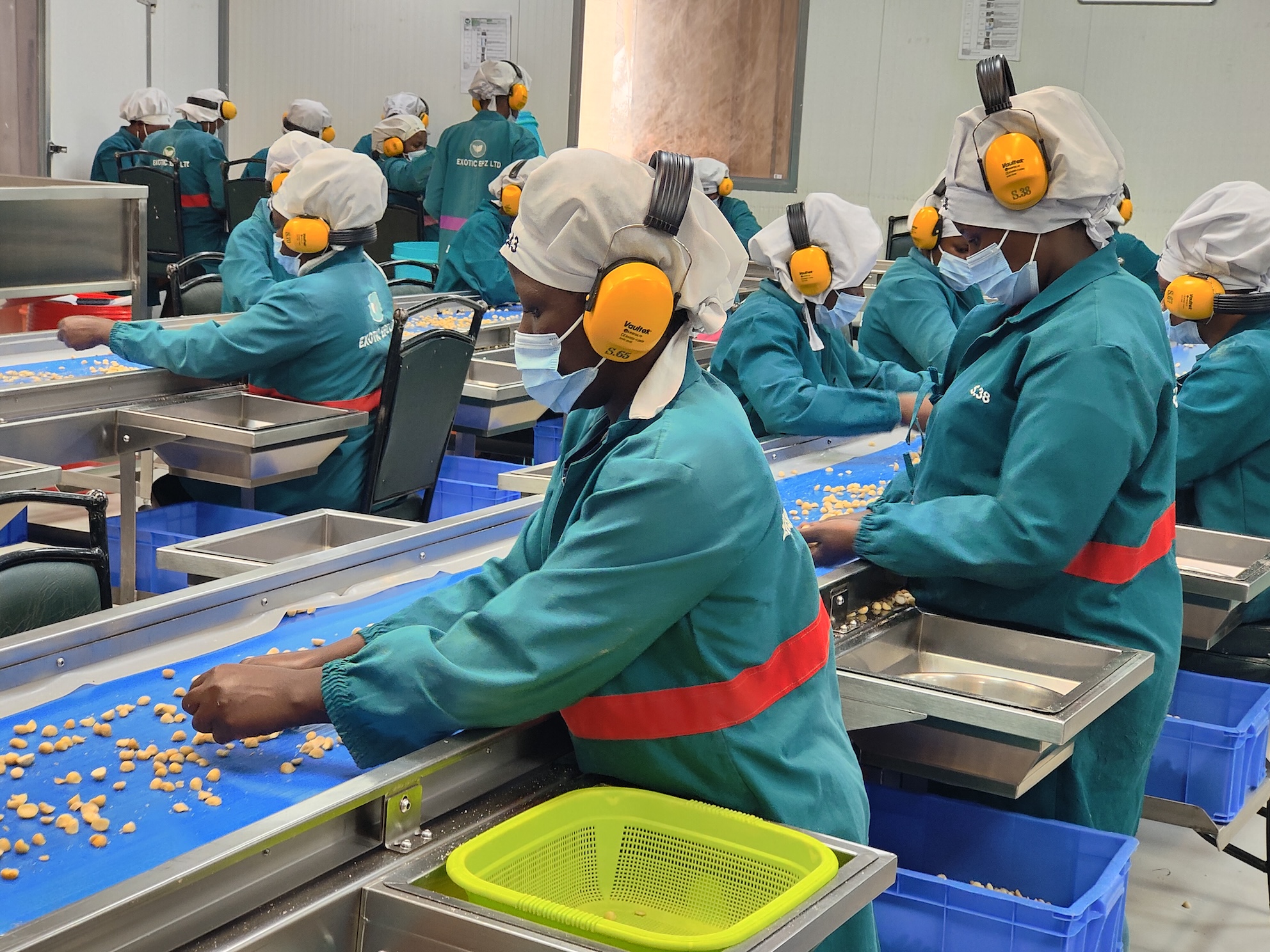
The women entrepreneurs interviewed for our white paper are not waiting for the field to catch up. They are processing macadamia nuts in solar-powered factories, delivering fish from informal women’s savings groups, building insect-protein companies, and generating clean energy from agricultural waste. They are executing, often on a fraction of the capital their male peers receive, while carrying the additional weight of unpaid care, discriminatory collateral requirements and network exclusion.
Exotic EPZ: finding ways around systemic biasExotic EPZ is Kenya’s first 100% women-owned macadamia nut processing company. Its co-founders wanted to connect small family farms with global markets, as well as providing decent jobs.
The founders’ financing journey illustrates a structural barrier that women entrepreneurs often face: collateral. When co-founder Jane Maigua (pictured on the right, top) explored traditional bank financing, she ran into the familiar requirement for property as collateral. As a married woman she did not have deeds in her name. What followed was a patchwork of improvisation: personal savings, friends and family funding and eventually the acquisition of assets from a processor that was closing down. The business was ultimately unlocked through an exclusive supply agreement that provided upfront capital in exchange for below-market pricing and exclusivity. Since then, the business has strengthened. It illustrates how women founders can find ways around the system, but at a cost that better designed gender-lens investing should be trying to reduce. Exotic EPZ is one of the female-founded enterprises featured in the white paper. |
The capital is not absent. The commitment is not absent. What is missing is the alignment: between instruments and needs, between accountability and resourcing, between gender-lens branding and gender-lens substance. What’s more, we still see bias among investment teams when evaluating female-founded and female-led enterprises.
We must listen more closely to women entrepreneurs and shape the right financial products together
Closing that gap is the defining challenge, and the defining opportunity, for gender-lens investing in Africa in the years ahead. We must listen more closely to women entrepreneurs and shape the right financial products together – this is why our white paper highlights their voices.
Our suggestions for investors include the following:
- Match instruments to needs, not models: impact investing must develop its own fit-for-purpose capital architecture instead of copying VC structures and hoping they work in very different markets. These could include innovative financing models that consider alternatives to property collateral, provide longer and more flexible payment periods or offer non-dilutive redeemable equity.
- Design for the missing middle: funds should offer purpose-built ticket sizes, longer investment horizons that give time to build a resilient business and accept more modest financial returns in exchange for stronger resilience and transformative impact.
- Finance should be matched to business cycles: enterprises need seasonal working capital to pay farmers, longer-term asset finance and patient capital for product and market development.
- Examine internal power and decision-making structures: increasing diversity in decision-making roles can materially shift capital allocation outcomes.
- Adapt accountability to resourcing: expectations, milestones and timelines should reflect the actual level of capital deployed and enterprise capacity.
- Provide technical assistance: this should help enterprises to translate capital into sustainable growth.
We invite partners and gender-lens investors to join us in advancing a new phase of impact investing – one that moves beyond replicating conventional venture capital models and instead prioritises equity, shared value and long-term resilience.
Rethinking Gender-Lens Investing in East Africa was launched at the Social Enterprise Open Camp which is taking place from 21 to 24 November in Bologna, Bertinoro, Forli and Cesena in Italy.
Header photo: Exotic EPZ founders Jane Maigua and Charity Ngedwa with one of the farmers that they work with
Elisabet Nyquist is general manager of OPES-LCEF

| Ready to invest in independent, solutions-based journalism?
Our paying members get unrestricted access to all our content, while helping to sustain our journalism. Plus, we’re an independently owned social enterprise, so joining our mission means you’re investing in the social economy. |
