


NPC’s ‘impact economy’ definition: a ‘missed opportunity’ or chance to collaborate better?
As the agenda gains traction in the UK, leading voices from social enterprise, co-operatives and social investment have raised concerns over a definition of the ‘impact economy’ in a recent report that risks alienating a number of impactful organisations.
“Groundbreaking”, “landmark”, “much-needed”: these were among the reactions to Impact UK, a report by New Philanthropy Capital which took on the ambitious task to create the first mapping of the UK’s impact economy – a relatively new concept referring to the broad ecosystem of entities “prioritising impact over private gain”.
Its findings were striking: the impact economy contributes £428bn to the UK’s economy, representing 15% of the country’s GDP. At last, the sector had a number to put forward to policymakers when making the case for more support for impact-led organisations and capital providers.
But what’s included in the impact economy? While NPC researchers were at pains to say they wanted it to be inclusive, they had to decide on a definition to be able to size it. But it proved controversial: while charities, community interest companies, ‘impact-led businesses’ were in, co-operatives and employee-owned businesses were not systematically included – to the surprise of many.
Fears have emerged of a "missed opportunity”, for those who see co-operatives and employee-led businesses as impactful by design and a core part of the impact economy. Why does it matter? We hear the arguments from leaders from the co-operative, social enterprise and social investment sectors, as well as NPC's response.
Mutuality and impact
The report describes the impact economy as “an ecosystem of individuals, organisations, and capital intending to prioritise public benefit over private gain”.
NPC researchers split impact economy organisations in two groups: the “regulated impact economy” – organisations that are bound by their legal form to provide benefit to society or the planet – and the "unregulated impact economy” – most of them impact-led businesses, that have not adopted a binding legal structure but demonstrated their intention to prioritise positive impact.
For the first category, researchers systematically included some legal forms such as charities and community interest companies (CICs). For the second, researchers assessed whether a business was “impact-led” following a methodology that looked at various parameters including intent and business model.
Co-operatives and employee-led businesses were listed in the report among organisations which, while they “incorporate elements of value sharing”, do not “clearly satisfy” the report’s definition, and as a result are not included in the impact economy.
Researchers have since clarified that many co-operatives and employee-owned businesses were included, as long as they met other criteria in the definition, such as having a relevant legal form or meeting the test for “impact-led business”. But being a co-operative or an employee-owned business alone wasn’t enough to be considered part of the impact economy.
There is a fundamental connection between mutuality and impact
This came as a shock for many leading figures in the impact sector who argued that co-operatives and employee-owned businesses were, by nature, prioritising public benefit over private gains because they were built on shared ownership and democratic governance.
James Wright, Policy and Development Lead at Co-operatives UK, the trade body for co-operatives in the UK, said: “There is a fundamental connection between mutuality and impact, and I have got a sense that was pretty much ignored in the way [NPC] went about the report.”
He added: “By design, whether it's a co-operative, whether it's a building society, whether it's an employee-owned business, they don't exist to generate distributable profits. They exist to create mutual benefits.”
What’s a co-operative?According to the revised Statement on the Cooperative Identity adopted in 1995 by the International Co-operative Alliance, a co-operative is “an autonomous association of persons united voluntarily to meet their common economic, social and cultural needs and aspirations through a jointly owned and democratically-controlled enterprise”. The statement specifies that “co-operatives are based on the values of self-help, self-responsibility, democracy, equality, equity, and solidarity” and that “co-operative members believe in the ethical values of honesty, openness, social responsibility and caring for others”. Co-operatives follow seven “co-operative principles” including: voluntary and open membership; democratic member control; member economic participation (members contribute equitably to the capital of the organisation); autonomy and independence; education, training, and information (for their members and the general public); cooperation among cooperatives; and concern for community. There are more than 7,000 co-operatives in the UK, according to recent research from Co-operatives UK. |
 Erwin Hieltjes (pictured), director of data and impact at NPC, said researchers considered that not all co-operatives were impact-led, and that benefitting members didn’t necessarily mean benefitting broader society.
“We think co-operatives are part of the impact economy, but just because you are a co-operative does not mean that you are always part of the impact economy,” he said.
“On one hand, many, many co-operatives will be part of the impact economy… but if you distribute profit to all your employees, you're making loads of profits, and you don't care about the wellbeing of the community and the environment – I want a debate: are you part of the impact economy?”
Confused and disappointed
Wright said Co-operatives UK was “confused, surprised and probably a bit disappointed” by the NPC publication, and the organisation did not know about the report until it was published. Ever since discussions about the ‘impact economy agenda’ started gaining traction within government, he said co-operatives and employee-owned businesses had always felt included.
Wright pointed to an influential report published last autumn by the UK government’s Social Impact Investment Advisory Group (SIIAG) with a set of recommendations for the government to support the impact sector, which led to the creation of the Office for the Impact Economy.
The report explicitly lists co-operatives and employee-owned businesses as part of “purpose-driven businesses”: “Purpose-driven business encompasses a wide-range of entities including mutuals, co-operatives, employee-owned businesses, social enterprises, and charities, all sharing the aim of delivering a strong economy where society profits.”
- Find out more about the SIIAG report recommendations
The Labour government is likely to have a sympathetic ear to the argument made by co-operatives, not least because many Labour MPs are also members of the Co-operative party, and it has committed to doubling the number of co-operatives in the country.
A definition that might stick
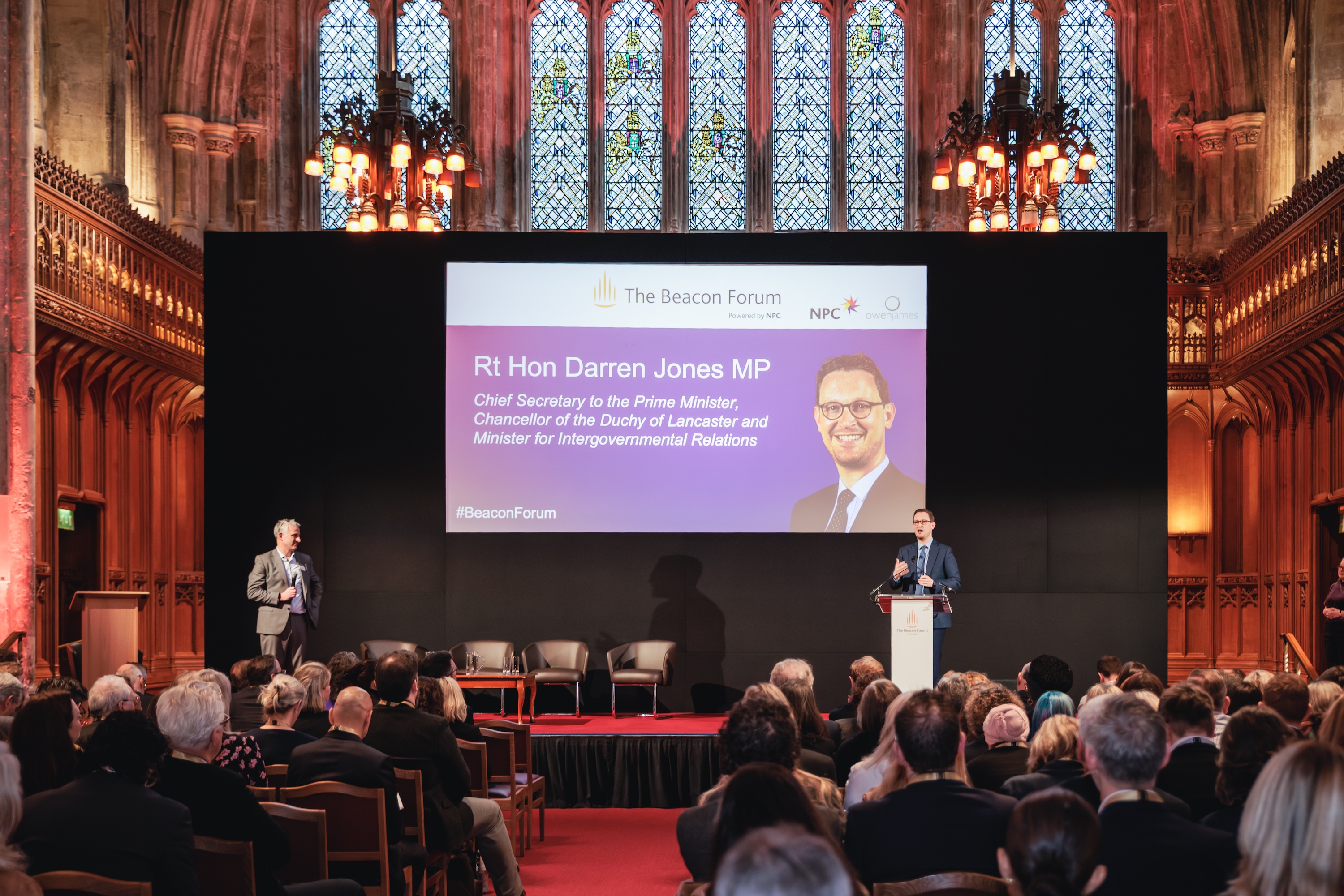
Chief secretary to the prime minister Darren Jones speaks at the Beacon Forum, organised by NPC in February.
How problematic the NPC definition will be depends on how much of a reference it will become for policymakers and funders.
Hieltjes insisted that NPC did not intend to create an official definition of the impact economy, instead it should be seen as a starting point for discussions, and he welcomed the debate around it. “It is an evolving term, and it's not up to us to say this is the one definition,” he said. “We very much see this as a conversation starter.” It was particularly difficult to set boundaries given the multitude of legal forms that impact economy organisations could take, he added, making data-gathering challenging.
It is an evolving term, and it's not up to us to say this is the one definition
But many people are concerned the definition is likely to stick. “There's a particular risk if this gets taken seriously by government as a definitional work,” said Wright. “If this particular impact economy agenda is such a significant part of what the government is trying to do to reform the economy, and get more of the right types of finances and delivering social environmental impact alongside economic return – which we think co-operatives and mutuals are really well placed to do – there's a chance that we would miss out.”
Internationally, co-operatives have historically been included in official definitions of the “social economy”, including in the European Union and in the United Nations. (Hieltjes said the NPC research focused exclusively on mapping the landscape in the UK.) Being included in those definitions matters – in the EU, that means co-operatives can access support through the Social Economy Action Plan, for example, and the UN resolution on the social economy calls on governments to adopt policies supportive of social economy organisations.
Talking about “impact economy” is “relatively new language” said Peter Holbrook, CEO of Social Enterprise UK. He argued that, while he welcomes the report, which “creates a really important discussion and conversation which we need to have”, the question about what was and wasn’t included needed close attention because it was likely to influence the work of the government’s Office for the Impact Economy.
“My theory is this is being driven by a sense of what's investable, rather than what's impactful. And that probably is the crux of the problem.”
Co-operatives and employee-led businesses have very specific requirements when it comes to taking on investment, as they need to “do so on terms that ensure democratic control by their members and maintain their cooperative autonomy”, according to the International Co-operative Alliance.
Focus on intent
The NPC researchers reached out to a number of organisations to discuss their approach, and said discussions highlighted the importance of intentionality – whether the business’s purpose was to create a positive impact. “Then as a team, we've taken that intentionality as one of our key concepts” to inform the report’s approach, Hieltjes recalled. “If you are organising a cooperative, and you're doing it because that's the best way to split your million dollar profits among your law firm, is that an intentionality to have a good impact in society?”
Organisations consulted by NPC didn’t include Co-operatives UK, but numbered, among others, government bodies, B Lab UK, Pro Bono Economics, Charities Aid Foundation, the Association of Charitable Foundations, the Charity Commission for England and Wales, Better Society Capital and Social Enterprise UK. SEUK confirmed its representatives attended a workshop last summer, but a spokesperson added it had not been in touch with NPC since October, when they had an email exchange about finding data on CICs, and did not see a draft of the final report.
A question of power
 For Bonnie Chiu (pictured), co-founder of Pathway Fund and managing director of the Social Investment Consultancy, the NPC definition reflected a broader lack of attention to business ownership and governance. She argued that “the mainstream social impact space in the UK has not been directly confronting questions around ownership and governance, as they fundamentally relate to power”.
She describes the report as a “true missed opportunity as the UK has a longstanding history in mutuals and co-operatives – which are the precursor to any impact economy – and one of the most mature legal and taxation frameworks enabling employee owned businesses.”
Ownership, power, and economic design are not optional. They are foundational
“The NPC report defines the impact economy essentially as economic activity that signals public benefit while remaining structurally compatible with existing ownership and capital models.
“However, if the impact economy is meant to describe the economic transition required to deliver equality, resilience, and democratic agency – which I imagine many people will actually agree and aspire to – then ownership, power, and economic design are not optional. They are foundational.”
The way forward
Hieltjes said NPC had proactively responded to concerns, and it has published a blog clarifying that while co-operatives and employee-owned businesses aren’t counted in by default, many of them are in practice included because they match other criteria, something that was initially misunderstood by many.
He said: “It's great that people are engaging and letting their voice be heard on what they think is the impact economy, which I think is really, really good.”
The team was revising some aspects of the report, Hieltjes explained, in particular around including co-operative societies (a legal form adopted by some co-operatives), and would seek to clarify some language that authors said might have led to confusion. But it still did not intend to include all co-operatives by default. Hieltjes said a revised version of the report was in the making but no timeline for publication could be provided at this stage.
Meanwhile, Hieltjes said NPC had reached out to Co-operatives UK and planned a CEO meeting in the near future for further engagement.
He added: “We want [the impact economy report] to be inclusive… maybe the next iteration will decide, actually, in order to be inclusive, let's just include all of them [co-operatives and employee-owned businesses], always, and maybe put a caveat [for some exceptions]”.
Co-operatives UK’s Wright said he was hopeful about the upcoming discussions: “The definitions that [the researchers] use of the impact economy and impact-led organisations are quite broad, and I think, potentially could be quite inclusive,” adding that Co-operatives UK felt that co-ops and employee-owned businesses could be included within these definitions.
We want that explanation and clarification to feed over into the Office for the Impact Economy as well
He added he appreciated NPC getting in touch to have more detailed conversations. “But we also do want to pick up this conversation with the Office of the Impact Economy, because whilst we know it wasn't their report, we do know that they would have received it and read it. As much as we want to do some explaining and interrogation with New Philanthropy Capital, we want that explanation and clarification to feed over into the Office for the Impact Economy as well.
“You are not going to solve society's problems just by having private capital doing some good on the side,” he added. “We think if you want to go further and have an impact economy which is really about being distributed by design, empowering and benefiting more stakeholders in society, you really need to be making sure that co-operatives and mutuals are operating in as enabling conditions as possible... The impact economy agenda could really do that, or could be an important part of that – but there’s a risk that it won't be.”
Top image: Freepik.

| Ready to invest in independent, solutions-based journalism?
Our paying members get unrestricted access to all our content, while helping to sustain our journalism. Plus, we’re an independently owned social enterprise, so joining our mission means you’re investing in the social economy. |