

The Editor's Post: Rewiring Scotland's economy, neighbourhood by neighbourhood

'You will need an act of parliament to stop doing community wealth building,' says government minster at Social Enterprise Summit Scotland.
When Scotland became the first country in the world to legislate for the community wealth building economic model in February 2026, the world took notice.
The legislation requires ministers and various public bodies, particularly local authorities, to publish and implement community wealth building action plans, which will see wealth kept within the local economies in which it is generated.
This could include boosting social enterprises, buying or procuring more goods and services from local businesses or helping community groups to acquire vacant buildings and land.
As we’ve reported, the legislation was seen as groundbreaking, receiving media attention and accolades from across the world. But, since the bill passed, progress has been largely on pause, primarily held up by a general election in May.
The election was won by the incumbent Scottish National Party which had introduced the community wealth building bill. So, although implementation of community wealth building may be just getting started, the government is sure of one thing: it is here to stay.
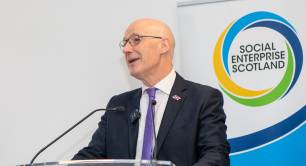
That was the message from the business and fair work minister Tom Arthur who delivered the keynote speech at the Social Enterprise Summit Scotland, which I attended in Dundee this week.
Acknowledging that social enterprises had been enacting community wealth building for decades without legislation, Arthur said: “You don't need an act of parliament to do community wealth building. But now you will need an act of parliament to stop doing community wealth building.”
Public service reform would be the “defining issue of this parliament”, said Arthur, and “social enterprises and the wider inclusive and democratic business model economy is going to be absolutely crucial in realising those ambitions”.
Arthur, who worked on the legislation as community wealth building minister until he changed role in 2024, positioned the economic model as part of a response to the “long, miserable tail” of the 2008 financial crash which he said we’re still living in.
“We're not going to undo all of the social and environmental damage that's been taking place under the prevailing economic model, and we're not going to be able to transition to a new economic model, in one fell swoop,” he said. “But we can, through an iterative process, neighbourhood by neighbourhood, community by community, region by region, start to rewire how Scotland's economy operates.”
New MSP Hannah Mary Goodlad now holds the community wealth building portfolio. Andy Paterson, policy officer at Social Enterprise Scotland (organiser of the Social Enterprise Summit Scotland), expects a programme for government, including community wealth building, to be published in September.
We’ll be sure to keep you updated on community wealth building in Scotland as the roll out progresses.
What impact-first really means
Also this week, we report upon fascinating research from the US-based Miller Center for Global Impact which quantifies for the first time the “tradeoff” between impact and financial return for investors, showing that ‘impact-first funds’ must spend an extra $0.13 per dollar to deploy their investments compared with traditional funds. This certainly isn’t inefficiency, the researchers emphasise, but it’s the necessary price that must be paid to get investment into the hands of the high impact social enterprises that really need it, and the money working properly on the ground.
Alongside that, Caroline Bressan, CEO of Open Road Impact (and one of the participants in the Miller Center research), argues that too much so-called impact capital doesn’t actually put impact first. While it’s widely reported that there’s a massive US$1.5tn of assets in the marketplace, social entrepreneurs feel increasingly disconnected from it.
We look forward to seeing how the ‘impact-first’ debate develops.
Join our impact storytelling workshop
Pioneers Post editors Anna Patton and Julie Pybus are running another edition of our popular impact storytelling workshop, delivered in partnership with School for Social Entrepreneurs, on Tuesday 14 July.
The online, half-day session will offer practical tips and inspiration to help you uncover, shape and share the stories that drive action. It covers topics including the psychology and key elements of stories, ethical storytelling, aligning your comms with your business strategy, and working with the media. Don’t miss out - sign up now!
This week's top stories:
Ricola and Rituals among first B Corps certified under new standards
The Impact World this Week: 19 June 2026
Top image: Tom Arthur MSP speaking at the Social Enterprise Summit Scotland 2026 (credit: Open Aye, for Social Enterprise Scotland 2026)

| Ready to invest in independent, solutions-based journalism?
Our paying members get unrestricted access to all our content, while helping to sustain our journalism. Plus, we’re an independently owned social enterprise, so joining our mission means you’re investing in the social economy. |