


Mission-led businesses number 150,000 in the UK, but face structural barriers to growth – new research
Mission-led businesses are more resilient and grow faster than the UK average, but they still only represent a small fraction of the UK’s business landscape, reveals study of Companies House data produced by Allia Impact and Beauhurst Insights.
There are more than 150,000 mission-led businesses in the UK, generating an annual turnover of £37bn, according to new research published this week by consultancy Allia Impact and market intelligence firm Beauhurst Insights.
Mission-led businesses are defined by the researchers as “trading enterprises that show a clear commitment to a social or environmental purpose – whether through their governance structures, their products or services, or the communities they serve”.
They span from recognised social enterprises to B Corp and commercial enterprises with “credible social and environmental missions”, and the authors explain they have used a “broad, inclusive framing” and are not intending to "settle a definitional debate”.
The study, The Impact Business Tipping Point: A Census of the UK’s Mission-Led Business Landscape is based on publicly available data from Companies House, the UK government’s registry of incorporated companies. The study focuses on MSMEs and automatically excluded some sectors, such as defence.
It reveals the number of mission-driven businesses has grown faster than UK businesses overall over the past ten years – going up about 61% compared with 42%, according to Companies House data. They also prove more resilient, with higher survival rates after five years of operations.
This challenges the misconception that prioritising impact comes at the expense of business growth
Martin Clark, CEO at Allia Impact, said: “For too long, the data on mission-led businesses has been inconsistent and hard to compare over time, despite the real economic and social value they deliver across the UK. This census changes that through a transparent and repeatable methodology, revealing a sector that is growing faster, and surviving longer than the wider UK business population. This challenges the misconception that prioritising impact comes at the expense of business growth.”
But the report also notes that mission-led businesses only represent 6.3% of UK businesses considered in the study, and highlights barriers they face, in particular around fundraising.
“Mission-led businesses continue to face structural barriers that generic support cannot address,” Clark added. “But with the right action, the UK can move from measuring the impact economy to building it, reaching the tipping point where mission-led business becomes the norm, not the exception.”
Mission-led businesses in the UK in 2026
|
The study is intended to provide data to practitioners, investors and policymakers to inform decisions to support mission-led businesses across the country. “It bridges the gap between the high-level narratives about the impact economy and the on-the-ground reality that capital allocators and support organisations need to navigate,” Clark writes in the report’s foreword.
The report adds to existing research on the UK’s impact economy. In February, New Philanthropy Capital published a report seeking to size the impact economy more broadly (not only impact-driven businesses) which found that it contributed £428bn, or 15%, of the UK’s GDP. NPC defined the impact economy as “an ecosystem of individuals, organisations, and capital intending to prioritise public benefit over private gain”, and the study came under fire for its decision of including some entities and not others.
Two different groups
The methodology involves reviewing all of Companies House data and identifying which businesses fit the mission-led definition, by using filters such as legal forms, certifications, keywords and activities, and using AI to analyse whether their articles of association commit them to a certain social or environmental mission.
It splits mission-led businesses in two groups: “impact-first”, which are businesses that have a strong, explicit mission that is enshrined in specific company legal structures – typically with asset locks or dividend caps, such as community interest companies, which represent 80% of that cohort – or through their articles of association. The researchers numbered 63,083 such companies in the UK, with an aggregated annual turnover of £18.2bn, supporting 474,217 jobs.
The other category includes “balanced businesses”, which show “a strong social or environmental mission through their operations or public commitments, but without formal asset locks or profit distribution caps”. The study estimates there are 88,414 balanced businesses in the UK, representing an annual turnover of £18.7bn and supporting 653,903 jobs.
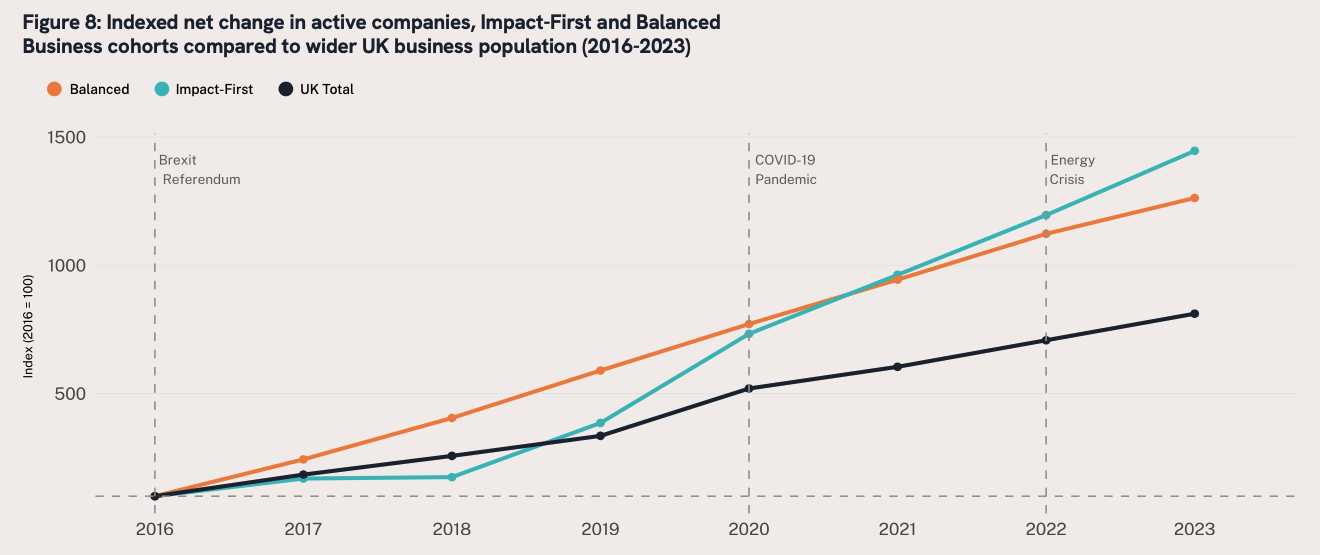
Above: both impact-first and balaned businesses have seen their number grow faster than the wider UK business population over the past 10 years. Source: Allia Impact/Beauhurst Insights, 2026.
The data shows both cohorts have distinct features. One notable difference is their maturity. Impact-first enterprises have a median age of 5.9 years. The researchers have used Beauhurst’s existing methodology to assess the growth stage of a company, by following “tracked signals” indicating growth, such as receipt of equity funding, accelerator attendance, academic spinout status, or appearance on a high growth list. It shows that less than 1% of active impact-first companies show any such signals, “suggesting the overwhelming majority operate entirely outside the formal growth finance and innovation support ecosystem”. In contrast, balanced businesses have a median age of 8.7, and 8.6% of them show some of Beauhurst’s “tracked signals” for growth.
- Read more: UK social enterprises’ resilience is being ‘chipped away’ by economic crisis, SEUK report reveals
Investment is also a substantial difference between the two groups. Impact-first businesses have raised £116m since 2011, although this is heavily distorted by a single deal (which the research didn’t identify), meaning equity funding among this group is “sparse and small in scale”. Over the same period, balanced businesses have raised £27.9bn in equity across 15,672 deals. In terms of debt funding, impact-first businesses have raised £18.4m in debt and mixed financing across 24 deals, compared with £2.42bn across 1,038 transactions for balanced businesses.
This is due to most impact-first businesses’ legal structure: companies limited by guarantee cannot issue shares, and CICs have asset locks and dividend caps that prevent the accumulation of capital. Their lenders generally include specialist social investors or government-backed schemes. To help overcome this barrier, the report recommends the recognition of a legal structure for “hybrid” models that would enable businesses to legally lock in their mission without being prevented from raising capital. It gives examples such as the “entreprises à mission” in France or “società benefit” statuses in Italy.
|
In numbers: ‘Impact-first’ and ‘balanced businesses’
|
What’s included, and what’s not
The study is focused on micro, small, and medium enterprises (MSMEs) – excluding businesses of more than 250 employees or total assets exceeding £27m. It also sets a minimum balance sheet threshold of £5,000, to exclude “very small, potentially non-employing businesses”, apart from CICs. The authors are hoping the methodology can be repeated to provide comparable data over time.
Because the study is based on Companies House data, entities such as housing associations, community benefit societies, co-operatives and non-trading charities that are not registered there are not included. Certain sectors, such as defence and military, are automatically excluded. The authors also acknowledge that the methodology does not capture “silent” impact that is happening on the ground but not expressed in the publicly available information the research is based on.
Top image: BelleVie provides home care delivery, built around small, self-managing teams across Oxfordshire, Buckinghamshire, and the north east of England. It replaces hourly payments by a monthly subscription model to remove the transactional feeling often associated with care, and values its workers, reducing staff turnover.

| Ready to invest in independent, solutions-based journalism?
Our paying members get unrestricted access to all our content, while helping to sustain our journalism. Plus, we’re an independently owned social enterprise, so joining our mission means you’re investing in the social economy. |