Collection: Awkward questions


Do small ethical brands too often become a lifestyle choice for the rich, rather than a system-changing response to the fundamental problem we’re aiming to tackle? Aliza Ayaz, whose family runs a social enterprise producing sustainable couture and jewellery, wonders if social entrepreneurs are too easily flattered by the story they want to tell, rather than the reality.
In the impact economy we are fond of a particular story about fashion. The industry is broken, fast fashion is the villain, and the answer is to buy less and buy better, ideally from small, ethical, mission-led makers. I help run one of those makers, so the story flatters me. That is exactly why I have come to distrust it.
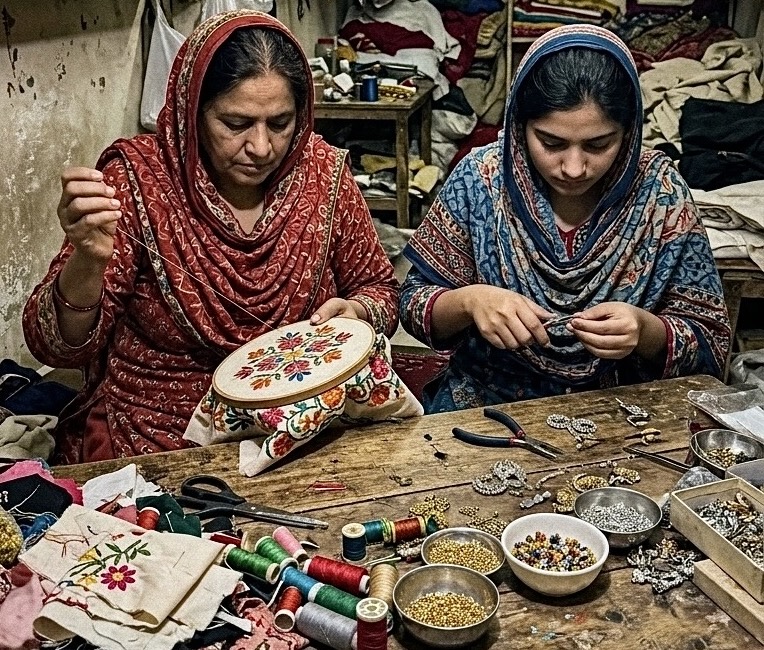
Let me be honest about what we do, because honesty is more useful here than a pitch. Araad Atelier is a small family social enterprise producing sustainable couture and jewellery. We make slowly, in small numbers, to last, combining Pakistani and European silversmithing traditions, and a share of what we make goes to social causes. I am proud of it. I also know that everything I have just described could be true and the venture could still be, at a systemic level, close to irrelevant. Both things can hold at once, and pretending otherwise is how our sector comforts itself.
Here is the uncomfortable arithmetic. The global fashion industry produces somewhere in the order of 100bn garments a year. Everything my workshop will ever make, across its whole existence, would not register as a rounding error against a single day of that. When we tell ourselves that ethical makers are the answer, we are describing a solution whose maximum possible scale is a fraction of a fraction of the problem. That does not make the work worthless. It makes the claim we quietly attach to it false.
I have learned this partly by getting things wrong. When we started, I assumed that if we simply made beautiful, durable, fairly made pieces, the case would make itself and demand would follow. It did not. Doing things properly is expensive, and the honest price of fair labour, real materials and time is a price most people cannot or will not pay. So the market for genuinely sustainable making skews, almost inevitably, towards those who already have money. We set out to challenge a wasteful luxury model and found ourselves being sorted, by economics, into a version of it. That is not a comfortable lesson. It is a true one.
We set out to challenge a wasteful luxury model and found ourselves being sorted, by economics, into a version of it
What worked was narrower than the story promises, and more valuable than I first understood. Small makers are not a substitute for structural change, but we are a working proof that another way is possible: that garments and jewellery can be made to be repaired and kept, that heritage skills still have a place, that value can loop back to people rather than only up to shareholders. Proof matters. It shifts what people are able to imagine. But proof is not the same as scale, and a sector that keeps confusing the two is going to keep losing the actual argument.
Because here is where I think the impact world lets itself off the hook. It is far more pleasant to celebrate the ethical maker than to fight the boring, structural battles that would actually move the numbers: making the big producers pay the true environmental and human cost of what they make, so that durability stops being a luxury and disposability stops being artificially cheap. Regulating volume. Pricing waste. Extending producer responsibility so that the company that made a garment is on the hook for its whole life. None of that is as photogenic as a hand-finished piece with a good story. All of it matters more.
And there is a sharper risk we rarely name. If supporting small ethical brands becomes the headline answer, it can function as moral cover for the system it claims to oppose. It lets the largest producers point to a thriving fringe of conscientious makers as evidence that the market is self-correcting, while they carry on making too much, too cheaply, too fast. A distraction does not have to be insincere to be a distraction. It just has to keep our attention on the comfortable part of the problem.
So am I saying makers like mine are pointless? No, and this is the distinction I want the sector to hold. We are not the solution, but we can be useful to it, on one condition: that we stop selling ourselves as the answer and start acting as evidence and advocates for the structural changes that are. That means being honest that buying better is not, on its own, a plan. It means small makers using whatever platform we have to argue for the policy that would make our way of working the norm rather than the expensive exception. It means measuring ourselves not only by what we make, but by what we help change beyond our own workshops.
We must stop selling ourselves as the answer and start acting as evidence and advocates for the structural changes that are
The most valuable thing my venture has taught me is not that small and ethical is the future. It is that small and ethical, left as a lifestyle choice for people who can afford it, will never be more than a beautiful footnote. Whether it becomes anything more depends on a fight that has almost nothing to do with what any of us makes, and almost everything to do with what we are willing to demand of the people who make the other 99%.
That is the awkward question I would put to my own sector. Not whether ethical making is good, because of course it is. But whether we are using it as a beginning, or hiding behind it as an end. I know which one I am guilty of on my worst days. I suspect I am not the only one.

| Ready to invest in independent, solutions-based journalism?
Our paying members get unrestricted access to all our content, while helping to sustain our journalism. Plus, we’re an independently owned social enterprise, so joining our mission means you’re investing in the social economy. |