

European social enterprises look to third party certification in face of ‘confusion’ over legal form
Social enterprises on the continent use hundreds of different legal shapes, driving organisations to turn to independent certifications for their impact to be recognised, according to a new Europe-wide study from Euclid Network.
Social enterprises in Europe are seeking validation from third party certifications and verifications in the face of “confusion” caused by the hundreds of legal forms and statuses adopted by organisations in the sector, according to new Europe-wide research from Euclid Network.
The study found that 364 different individual or combined legal forms and statuses were being used by a sample of 2,814 social enterprises from 38 European countries. Of the social enterprises sampled, 30% said they use at least one third party verification or certification.
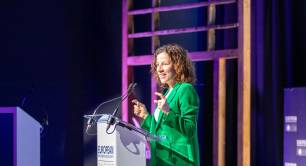
Toby Gazeley (pictured top), policy lead at Euclid Network, presented the findings of the study at the Social Enterprise Republic of Ireland (SERI) annual conference 2026, held this week in County Meath, just north of Dublin. He said the “confusion” of legal forms indicates the value of third party verification to “to help genuine social enterprises to cut through the noise and have their impact recognised”.
Euclid published the main findings of the European Social Enterprise Monitor 2026, the upcoming fourth edition of a biennial survey-based study on social enterprises across Europe, yesterday. The European Social Enterprise Monitor is carried out by the Euclid Network, which represents social enterprises in Europe, and co-funded by the European Union (EU). The full findings will be published in February 2027.
Among the organisations using third party verification, the most commonly used was People and Planet First, which launched in October 2023, and is stewarded by the Social Enterprise World Forum (SEWF).
There are 470 European enterprises with People and Planet First verification across 24 different countries. Publication of the findings coincided with People and Planet First Week, an annual campaign run by SEWF to celebrate social enterprises, co-operatives, benefit corporations and more, which ran from 16-22 November.
 Gerry Higgins (pictured), SEWF founder and managing director, said verification enabled social enterprises to demonstrate credibility to customers, buyers, funders and government.
“In a market full of greenwashing and social washing, [People and Planet First verification] confirms that an enterprise exists to solve a social or environmental problem and reinvests the majority of its profit in that purpose,” said Higgins.
Because of the range of legal structures enterprises can adopt, the sector can be hard to explain to anyone outside it, believes Higgins. He said independent third-party verification allowed social enterprises and the model’s advocates to “tell one clear story about the sector's scale and impact”.
A recent report commissioned by the EU Commission found that mission-driven businesses more generally were suffering from a lack of EU-wide recognition. It mentioned a fragmented regulatory environment as a major challenge to improve support for the sector and access to markets, and called for an EU-wide single status, for example through the EU Inc. legal form currently being developed for startups.
Certifications such as B Corp have also ensured they are able to meet demand for third-party certification from European mission-driven businesses: B Lab’s latest standards update has been designed to be compatible for EU-wide regulation on greenwashing, for example.
Social enterprises in Europe are getting older and more profitable, but remain financially fragile
Of the social enterprises that responded to the survey, 42% reported making a profit or surplus in the last financial year, while a quarter more broke even.
That is a notable jump from the previous 2023-2024 edition of the Monitor, in which 30% of the 1,800 social enterprises which responded reported making a profit.
This year’s respondents are also slightly older than the previous edition, suggesting increasing resilience. In the 2026 study the mean age of social enterprises was 18 years, and the median age 11. In the 2023-2024 edition, the mean age of social enterprises was 16 and the median age 10.
But despite increasing profitability and resilience, the study suggests social enterprises remain small. It reported a median income of €230,000 and a mean income of €2.8m. More than half (53%) of those surveyed reported a higher income than in the past financial year.
The median number of employees was seven – the same number as the previous edition. Some 50% of the social enterprises in the survey would be categorised by the EU as micro enterprises, 29% as small enterprises, 9% as medium and only 2% as large.
Speaking at the SERI annual conference, Wieteke Dupain, CEO of the Euclid Network, told delegates she often sees social enterprises struggling to scale within the EU. “Successful entrepreneurs are forced to move with their families, sometimes even to the United States or China, to have larger markets, because it's very difficult to scale in Europe,” she said.
To back up her point, Dupain said the Monitor found that 54% of social enterprises reported difficulties in scaling internationally.
|
Characteristics of social enterprises in the European Social Enterprise Monitor 2026
|
How can the EU better support social enterprises?
When asked about barriers to success, the most common answer was “lack of access to finance” (cited by 33% of respondents), while 32% said the economic climate and 27% said the political/regulatory environment.
On average, survey respondents were unsatisfied with the level of political support provided to social enterprises at national, regional or local level, with the mean rating of political support at all levels only reaching 31 out of 100.
At the SERI annual conference, Sarah De Heusch, director of Social Economy Europe, pointed out that the European Parliament is currently deciding on its 2028-2034 budget, called the multiannual financial framework (MFF), which has significant implications for the level of support the bloc delivers to social economy organisations.
De Heusch said the EU’s current priorities are competitiveness and defence, and that “it isn’t looking too good” because “the social economy is not recognised as a competitive factor”. Social Economy Europe is going to publish a letter to EU member states calling for the inclusion of the social economy in the MFF, which De Heusch encouraged delegates to share.
The choice before Europe is not between being competitive or being social... our common objective should be to make our social model a source of competitiveness
Séamus Boland, president of the European Economic and Social Committee, argued at the conference that “the choice before Europe is not between being competitive or being social”, but instead “our common objective should be to make our social model a source of competitiveness”.
To better support social enterprises, Boland said the EU should ensure that “the platform for activity is fair, is equitable, has the right financial supports, the right legislative supports, and is led by the relevant ministers in the various governments”.
Top image: Toby Gazeley presents the main findings of the European Social Enterprise Monitor 2026 at the SERI conference this week. Credit David Lyons/Pioneers Post.

| Ready to invest in independent, solutions-based journalism?
Our paying members get unrestricted access to all our content, while helping to sustain our journalism. Plus, we’re an independently owned social enterprise, so joining our mission means you’re investing in the social economy. |