

UK impact investing market accelerates growth to exceed £110bn amidst global slowdown
An enabling policy environment in recent years has helped drive more capital towards impact, with pension funds seen as important players, according to new research from the Impact Investing Institute.
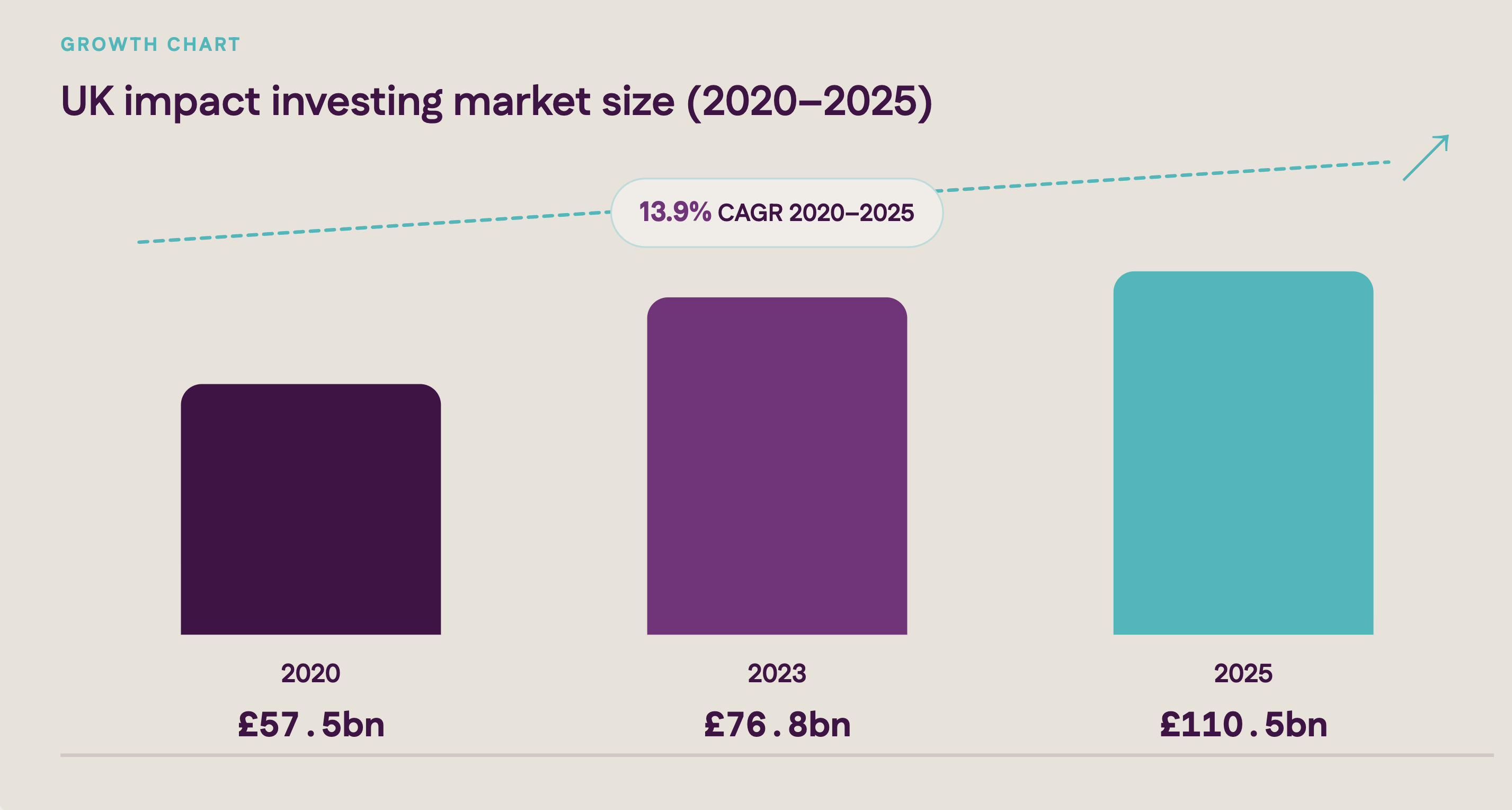
Impact investments managed in the UK reached £110.5bn at the end of 2025, a 44% increase on 2023 figures, according to the third edition of the Impact Investing Institute’s sizing of the UK impact investing market published yesterday.
This compares with a 33% expansion between 2020 and 2023, when the study was last published, signalling an accelerating increase, even as impact investments worldwide have been growing more slowly in recent years. Research published last month by the Global Impact Investing Network (GIIN) shows the global market has gone up just 12% over 2023-2025, down from 35% over the previous two years.
Source: Impact Investing Institute, 2026
The healthy UK picture demonstrates the resilience of the UK’s impact investing market, as well as the effects of a “positive policy enabling environment”, Sarah Teacher, co-CEO of the Impact Investing Institute, told Pioneers Post.
Pointing to the work of the Social Impact Investment Advisory Group and the creation of the Office for the Impact Economy, Teacher said: “2025 created this new chapter of interest of government partnership with private capital.” Meanwhile, ongoing work on clarifying pension funds’ fiduciary duties and commitments from institutional investors to boost investments played a role in encouraging impact investing, she said.
The report also points to the creation of the government’s £500m Better Futures Fund, an outcomes fund to tackle child poverty, and to the British Business Bank making mobilising institutional capital a “strategic objective” as other examples of market enablers.
“All of those big trends across 2025 have underscored why the UK has shown resilience and growth, notwithstanding challenges that have been a part of the reality of other global markets,” Teacher said.
|
What’s included The report, titled The UK impact investing market: Size, growth and direction, estimates the amount of direct impact investments for which the majority of investment management activities occur from the UK (the capital managed may be invested outside of the UK). It uses the GIIN definition of impact investing: “Investments made with the intention to generate positive, measurable social and environmental impact alongside a financial return”. The study is based on data from 96 organisations, collected through direct outreach and through partnerships with the GIIN, the Investment Association and Better Society Capital. Insights on investor practice is based on the UK sub-sample of the GIIN’s 2026 Impact Investor Survey. |
The challenge of changing the other 99%
Impact investing in the UK has outperformed the UK’s investment market as a whole, growing at an average 13.9% per year between 2020 and 2025, more than four times the rate of the broader market, which only increased by 3.3% a year on average.
But impact investments still only represent just 1% (up from 0.8% two years ago) of all assets currently managed in the UK – which total a record £11tn. “This leaves considerable scope for further growth,” according to the report.
 “We shouldn't discount the rapidity of the growth,” said Teacher (pictured), “[but] let’s not congratulate ourselves for the percentage of all financial system that we represent.”
She argued that impact investing had the potential to influence how the broader investment market operates. “To some extent, impact investing can be seen as a kind of research and development for where the investment system needs to go.”
Impact investing can be seen as a kind of research and development for where the investment system needs to go
She explained all investments had impact, with mainstream investors making social and environmental choices all the time, just not accounting for them. “They don’t think it’s their responsibility. [Impact investing] has woken up to its responsibilities, is delivering against those responsibilities, and showing it can do so whilst delivering strong financial performance, which I think is a great message.”
In the foreword to the report, Impact Investing Institute chair Kieron Boyle argues impact investing’s tools and practices “have much to offer capital markets as a whole”.
He said: “Impact investing has demonstrated that investment can generate financial returns while deliberately contributing to better outcomes for people and the planet. The task now is to take what we have learned and apply it far more widely. The question is not only how much impact investing can grow, but how much it can change the way we invest.”
|
The UK’s impact investing market in 2025: key findings
|
Drivers of growth: pension funds
The research only looks at direct investments (to avoid double-counting), so doesn’t provide data on who provides capital to investment managers, which account for 90% of the market. However, Teacher said targeted performance (largely market-rate) and the scale of investments suggest much of the increase has been driven by institutional investors (who hold large amounts of capital but can only take limited risks and have returns constraints).
Local Government Pension Scheme funds have already been clearly identified as drivers of growth for the more tightly-defined social impact investing market, in recent research by Better Society Capital. In addition to this, Teacher reckons some capital may also come from Dutch pension funds, which have actively committed capital to impact in recent years, choosing to invest some of their funds through UK investment managers.
- Read more: UK social investments top £13bn as pension funds fuel growth, reveals Better Society Capital
Echoing a pattern observed in the UK’s social investment market, social and affordable housing stands out as “one of the clearest areas” where institutional investors are allocating their money, the report notes. Researchers highlight the diversity of investors involved, from specialist social investors to mainstream banks, working in partnership to develop new models and provide capital at scale.
What’s next
The report finds that if the market were to grow at the same rate as it has since 2020, it would reach £200bn by 2030 – which Teacher argues is a realistic expectation, given the economic challenges the market has seen off over the past two years.
“Particularly considering the kind of geopolitical shocks that we've had in the last couple of years, I was really excited to see this number… It tells us that there is long-term conviction about capital allocation that delivers impact,” she said. “And the reason there is long-term conviction is because there are some fundamentals that we’re operating under: we have such a good line of sight now to the serious environmental and social systems risks, and with AI, that data clarity, that picture that we are investing into becomes clearer and clearer.”
That picture that we are investing into becomes clearer and clearer
Energy, healthcare (including social work), agriculture and water systems are cited as the top sectors in which UK impact investors surveyed are expecting to increase commitments. The report’s authors argue this shows investors are seeing resilience (the importance of energy, health and food security for example) as a “more prominent investment lens”.
Investing in those sectors enables investors to ensure the resilience of their portfolio, “while also allocating capital to solutions that strengthen resilience in the real economy”, the report notes.
Top image: stock (Magnific)

| Ready to invest in independent, solutions-based journalism?
Our paying members get unrestricted access to all our content, while helping to sustain our journalism. Plus, we’re an independently owned social enterprise, so joining our mission means you’re investing in the social economy. |