

UK social investments top £13bn as pension funds fuel growth, reveals Better Society Capital
Pension funds now make up one-third of social impact investing market, finds research published today, with institutional investors gaining confidence in several social impact asset classes, in particular affordable housing.
Social impact investments in the UK reached £13.2bn at the end of 2025, a 17% year-on-year increase, largely driven by more institutional capital flowing towards social and affordable housing, according to Better Society Capital’s latest market study.
The research, published today, reveals a record £2.2bn-worth of social investments were made in the 2025 calendar year, across just over 1,000 deals.
 “Given the scale of the need we continue to face as a country, it is encouraging to see this market continue to grow, putting more capital behind the organisations tackling social challenges, from homelessness to health inequality,” said Stephen Muers (pictured), CEO of Better Society Capital.
Jeremy Rogers, CIO at Better Society Capital, explained that new dynamics were bringing institutional investors into the market and predicted that they would now “stay and grow” over the long term.
Outstanding investments (the total investments made over time that are active at the end of 2025) in social and affordable housing were up 21% year-on-year, topping £7.3bn at the end of 2025, as the sector continues to account for the largest share of the market (55%). Volumes of capital invested in social and affordable housing in 2025 (the amount of new capital invested during the year) were up 13% compared with the previous year, reaching £1.2bn.
Social lending represents just over a third of the market (£4.7bn), similar to previous years. This segment saw 8% growth between 2024 and 2025, driven by non-bank lending (debt finance from social investment funds or others taken on by charities and social enterprises to provide working capital and growth finance) which saw outstanding investments increase by 31% and capital flows during 2025 went up by 45%. Bank lending, while accounting for more capital, experienced a smaller growth of 5% and investment volumes dropped.
Better Society Capital’s annual research is based on information from 100 different funds or social investment programmes that meet BSC’s criteria of ‘social impact investment’ in the UK, representing about 6,300 outstanding transactions.
|
What is social impact investment? Better Society Capital defines social impact investment as follows: “Investment into social purpose organisations, such as charities, social enterprises and start-ups, or into real assets such as social and affordable housing, that enables them to deliver measurable, lasting social impact. Investors seek a financial return alongside social impact, and both investor and investee must show clear social impact intent.” |
Pension funds as drivers of growth
The report notes that the growth in housing sector investments is led by pension and insurance capital, notably local government pension schemes (LGPS), with defined contribution pension schemes also starting to get involved. “As LGPS funds pool and look for long-dated, inflation-linked income alongside demonstrable local impact, affordable housing has become increasingly recognised as an asset class that can offer both at scale,” the researchers write.
Pension funds now account for a third of the total UK social impact investing market, according to the report’s analysis of investor types, up from a fifth two years ago. The amount of capital they have allocated to social investment has doubled over that time, from £2.1bn to £4bn – mostly into social and affordable housing. Meanwhile, insurance companies have trebled their commitments to social impact investing (albeit from a small base).
We believe these trends should see institutional investors stay and grow over the long term
Jeremy Rogers, CIO at Better Society Capital, told Pioneers Post several dynamics were bringing more institutional investors into the market, “and encouragingly, many of these look long-term or set to strengthen over time”. Government action has played a part, he explained, for example the Pension Schemes Act 2026 which requires local government pension schemes to invest locally, and the Mansion House Accords, through which a number of pension funds committed to boost investment.
“Several core social impact asset classes are also building the track records institutions need – affordable housing, for example, now has more than a decade of evidence behind it,” Rogers added. “Together with other initiatives such as the fiduciary duty guidance [updated government guidance, currently under consultation, to clarify pension funds’ fiduciary duties, which could change how they invest], we believe these trends should see institutional investors stay and grow over the long term.”
Bringing more local government pension schemes capital into social investment has been a focus of the sector for some time, and Rogers said its success was due to several factors, including government reform. But he highlights the role of impact-first investors – those ready to provide capital at higher-risk or discounted rates of return – in building the market. “We believe impact-first investors have also played their part – testing social impact business models, establishing best practice in impact measurement and management, and raising awareness of the opportunities. This work has laid the foundations LGPS investors have built on this year,” he said.
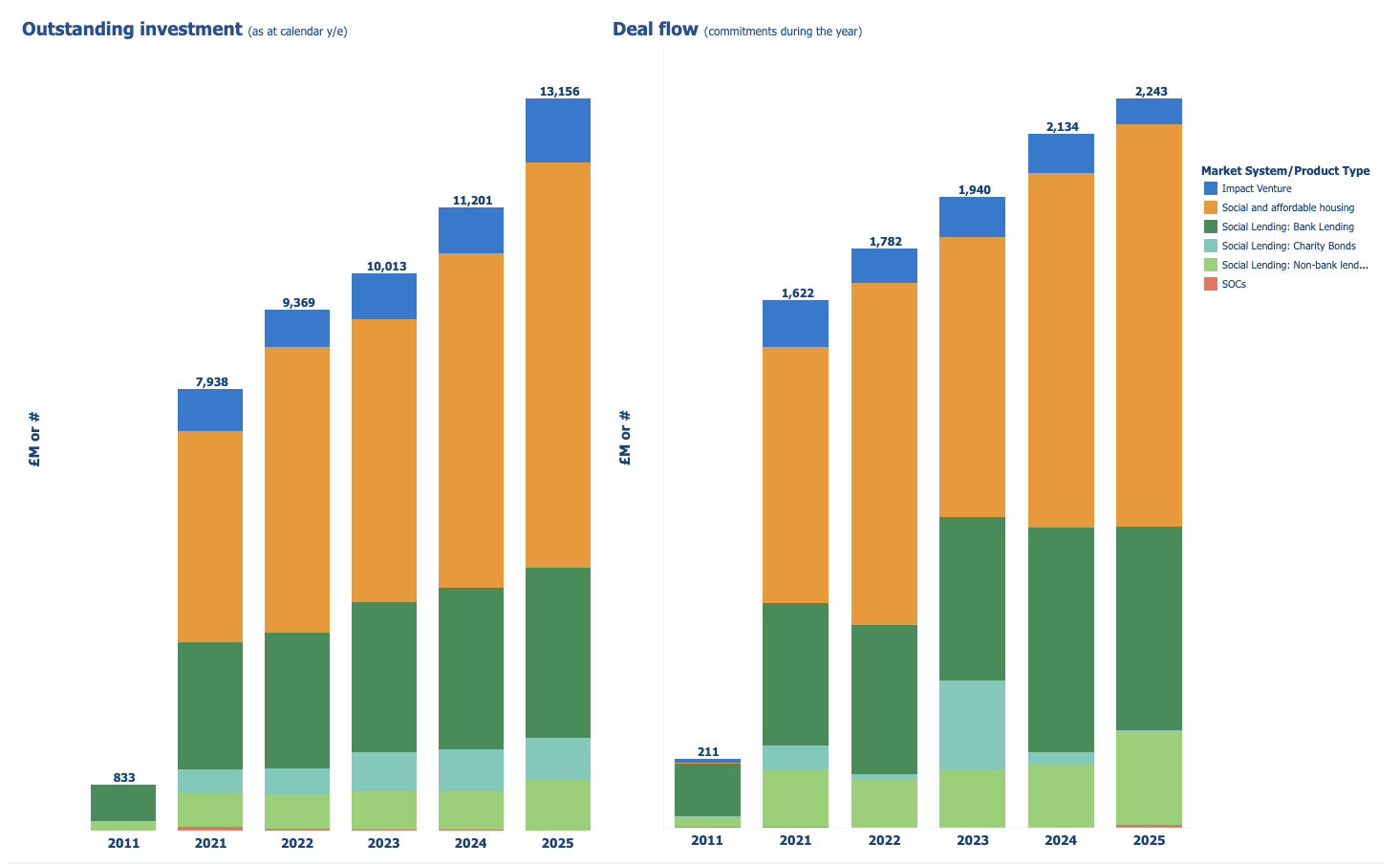
The UK social investment market as of the end of 2025. Source: Better Society Capital
What about high-impact, high-risk investments?
The second largest investor group after pension funds is endowments and charities (accounting for 13% of the market), which are key investors in social bank deposits and impact ventures, according to the report. Researchers note they “remain central to bringing innovation and collaboration to the market”.
Indeed, while institutional investors provide capital at scale to the market, they are so far mostly involved in the safer segments, such as social and affordable housing.
We have seen increased institutional investment into higher risk areas such as ventures where higher returns exist
“For institutional investors, it’s as much about return as it is about risk,” Rogers said. While they could be risk-takers, this needed to be offset by higher returns to meet their risk-adjusted returns objectives, like in other parts of the market they invested in, he added. “We have seen increased institutional investment into higher risk areas such as ventures where higher returns exist.”
To attract institutional investors to the riskier areas of social impact investment, tools such as guarantees and blended finance – where concessional capital can de-risk investments or bring them to necessary scale – can play an important role. “For example we have seen increased investment into social lending to frontline organisations supported by government guarantees, tax reliefs and grants from our sister organisation Access – the Foundation for Social Investment,” Rogers explained. Track record was also key, he added, as we see more investment flowing towards proven models with track records of over a decade.
A changing approach from government
Public finance institutions could also play a part in backing higher-risk areas, by providing capital on concessionary terms, said Rogers. The work of the British Business Bank in funding community finance institutions was one example of this, and last month’s budget allocated another £165m to the public bank to invest in CDFIs. “We see particular potential here over the next few years from government-linked bodies,” Rogers said.
The way government invests in social impact investing has changed, as it favours tools such as guarantees and blended finance over traditional grants. Rogers said: “There are a few reasons behind the shift: public finances are tight, so government wants every pound to go further and there’s growing recognition that social impact investment can help deliver core priorities, from local growth to financial inclusion and public service reform.”
Impact VC: is the 'missing middle' still missing?
Capital flows towards impact ventures (mission-driven startups) dropped by a third in 2025, but the size of outstanding investments in impact venture capital (equity investments made in impact startups) grew by 40%, exceeding the £1bn mark for the first time, thanks to the rising valuations of companies already invested in previous years.
Impact VC represented 9% of the overall social impact investing market at the end of 2025, up from 7% on the year before.
The researchers also found that, while less capital was committed to this part of the market in 2025 than in 2024, the number of deals had gone up, suggesting more investments in smaller early-stage rounds and fewer in larger growth deals – which could be seen as a concern for social ventures often struggling to access a “missing middle” type of investment, as they are too big for early-stage investment.
There would be value in more impact-oriented growth-stage capital being provided by the market
Rogers said it was too early yet to read into this year’s data, however “but we do think there would be value in more impact-oriented growth-stage capital being provided by the market, to help the strong early-stage impact companies we’re seeing continue to scale”.
Investments in social outcomes partnerships – which represent less than 0.1% of the market – remained low in 2025, and the value of outstanding investments of this type dropped by half year on year. This is due to some government schemes wrapping up (with capital being repaid to investors) and new ones, in particular the Better Futures Fund – which is expected to inject up to £1bn to tackle child poverty – yet to begin allocating money, the report explains. The effects of the Better Futures Fund will start being felt this year, but growth is likely to be slow and incremental, as the programme is rolled out over 10 years.
Top image: P3 Charity has received a £1.3m investment from Social and Sustainable Capital to deliver new supported housing in Rugby last summer.

| Ready to invest in independent, solutions-based journalism?
Our paying members get unrestricted access to all our content, while helping to sustain our journalism. Plus, we’re an independently owned social enterprise, so joining our mission means you’re investing in the social economy. |