
‘We are acting as pioneers to develop the true capitalism 2.0’ – Markus Freiburg, new chair of Impact Europe
INTERVIEW: The founding CEO of FASE knows what it means to do impact-first investing that works for social enterprises. As he takes on one of the most influential roles in the European impact investing community, he talks to Pioneers Post about the risks of underinvesting in social innovation, why impact investing needs to switch gears and the lessons he brutally learned from years trying to convince all investors to put purpose before profit.
When the Financing Agency for Social Entrepreneurship (FASE) was created 13 years ago, its mission was clear: supporting social entrepreneurs to access investment. Born of a partnership with Ashoka Germany, the Germany-based consultancy put the needs of impact founders at the centre of its work from the outset. So today, as more voices call for finance mechanisms that work for social entrepreneurs that have been traditionally underfunded by an impact investing market still obsessed with returns, it’s fair to say FASE knows what impact-first investing means.
And it might be a sign of a certain shift in zeitgeist that its founding CEO, Markus Freiburg, has been appointed to one of the most influential roles in the European impact investing community: chair of the board of Impact Europe, the organisation for impact investors across the continent now numbering 320 members. He succeeds the highly-respected Leslie Johnston, CEO of Laudes Foundation, who spent five years in the role.
When I meet him at the end of Impact Days, a mini-conference that Impact Europe organised in Brussels last month, I find him clearly relieved – Impact Europe’s AGM took place early that morning, and it was followed by a non-stop day of plenaries and workshops during which he delivered several speeches. “Talking to 300 people is not something I do at all in my everyday job,” he says.
Earlier in the day, he joked during a keynote about how, as a former McKinsey & Co consultant, he had a tendency to speak in three-point arguments – which his impressively structured responses during our conversation actually confirm. He speaks English with a slight German accent, precise and a little over-articulated. Altogether, he projects the image of a focused mind and a rare attention to detail.
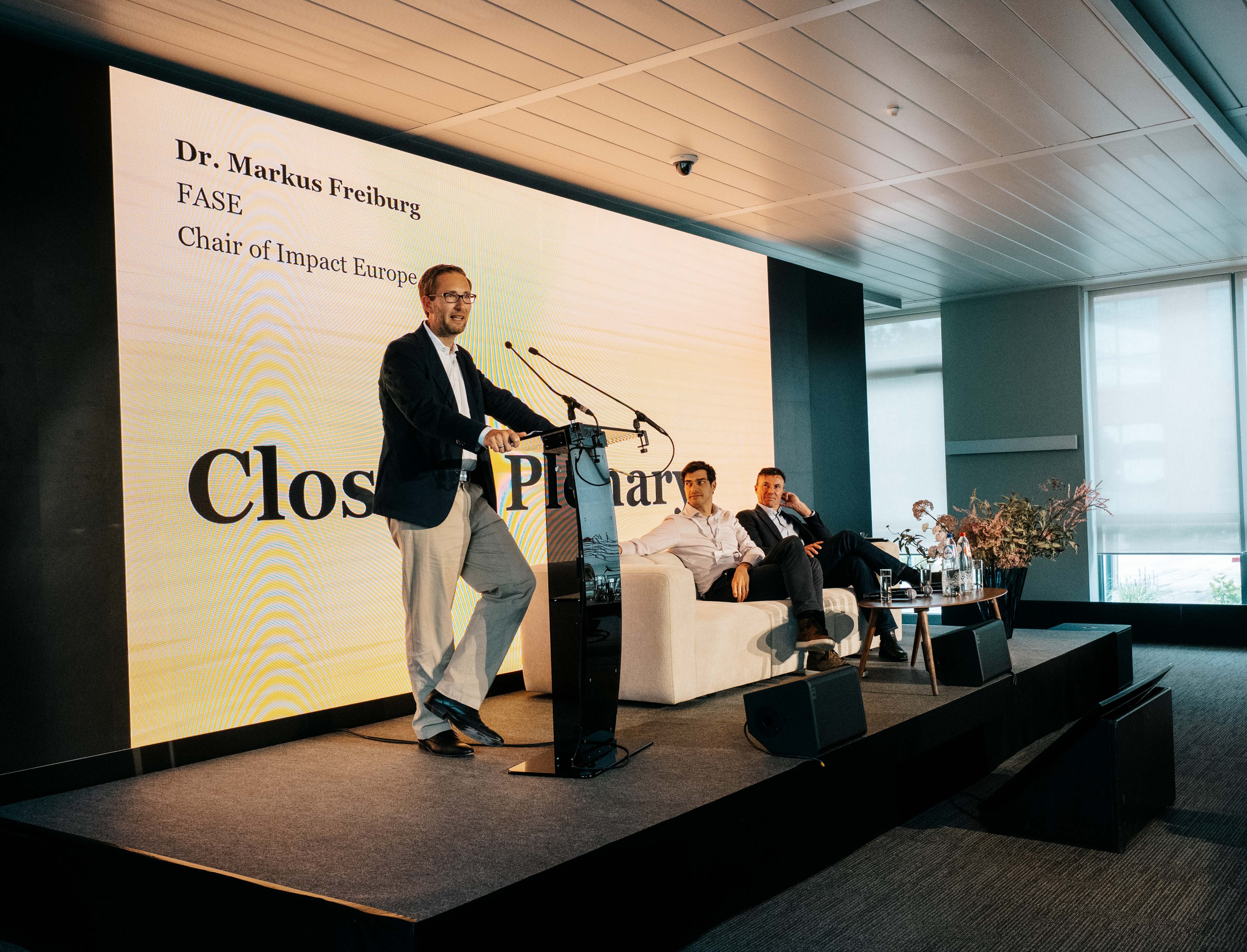
Above: Markus Freiburg speaks at Impact Days 2026 in Brussels
Today, FASE has a varied activity: in additional to its advisory work for social enterprises – supporting them to find investors, and delivering technical assistance to help them become investment-ready – it has also developed an “impact investing as a service offer”, helping non-expert investors develop small, targeted impact strategies for part of their portfolio. Finally, it develops co-investment funds, bringing diverse investors together in specific impact investing vehicles.
For Freiburg, his role at Impact Europe is a new opportunity to pursue his personal “theory of change”, expanding his own impact beyond what he could achieve otherwise. From its inception, FASE always had a focus on broader systemic shift thinking, and he has dedicated much of his own time to what he describes as “policy advocacy and ecosystem building” over the years, notably as a member of the Expert Group on Social Economy and Social Enterprises at the European Commission for nearly a decade.
Now his work at Impact Europe – of which FASE has been a member since 2014 and himself a board member for the past four years – is “very important to contribute to move the ecosystem forward”, he says.
Switching gears
Since its inception, FASE has supported more than 110 financing rounds and raised more than €100m. It has now set an ambitious target: to bring €1bn into the impact ecosystem by 2035: now is time to “switch gears and scale up”, says Freiburg.
And this goes for Impact Europe too. “How do we bring the great work that we have [done] collectively in the impact ecosystem to scale? We have developed very interesting models, but if you look at the last market sizing, impact is still just 3% of [eligible] assets under management in Europe.” The Impact Europe board has set what he describes as a “moonshot goal” to increase this share to 10% by 2030.
Achieving this will need bringing all types of investors to the table – from commercial investors with non-negotiable risk-return expectations to family offices, foundations and public money ready to accept lower financial returns in exchange for impact. This quest to mobilise the “whole spectrum of capital” is not a new approach – Impact Europe has been advocating for it for many years. But it can easily sound like an abstract concept at risk of remaining a nice chart in impact reports. For Freiburg this is actually what he does day in, day out at FASE – and he’s learned what works, what doesn’t, and what’s the way forward.
Underfunded social innovation
One of the impact sector’s biggest obstacles, from Freiburg’s perspective, is the obsession with what he describes as a “US-style venture capital”, or finance-first, approach taken by impact investors. Recent research from the GIIN shows that eight out of 10 impact investors are looking for market rates of return, he explains, “and therefore they are trying to apply the US VC model to impact ventures”, expecting them to grow fast and provide quick returns – which is incompatible with the business model of many social enterprises, because impact takes time. “That works on some occasions, like climate tech, where you usually have very scalable tech solutions, but this is only half of the solution,” he says.
Anything that is not “tech innovation” – meaning, most social innovation – is systematically left aside by this approach, he explains. And companies that don’t have “exit-oriented structures” – ventures that aspire to build a sustainable business model with both profit and purpose, but without the intention to sell the company quickly, such as steward ownership models – are chronically underfunded.
“By focusing only on this ‘US model’, we leave the full innovation potential aside, and that I think is something that we can just not afford,” he says, especially at a time when Europe is focusing on competitiveness and sovereignty.
Creating investment vehicles that are compatible with all impact ventures requires building partnerships between different types of investors, the “impact-first” ones ready to pay for impact, and the ones targeting market-rates of returns, resulting in impact-first, blended finance structures.
By focusing only on this ‘US model’, we leave the full innovation potential aside
He gives as an example the European Catalytic Impact Investing Fund II (ECIIF II), a co-investment fund for impact ventures in Europe which follows a successful pilot, the European Social Innovation and Impact Fund (ESIIF). ECIIF II has a target size of €80m, aiming to invest in 40 ventures. Its key ingredient is a €10m catalytic guarantee from Invest EU, a European Commission-backed programme. That means if investees default, Invest EU takes the hit first which protects the other investors. ECIIF II and its pilot are “the only funds across Europe providing patient capital to impact ventures and benefiting from guarantees from the European Commission”, explains Freiburg.
The “beauty of the guarantee” is that it immediately “expands the universe of impact ventures” that the fund can invest in – including the social innovation and legal structures typically ignored by VC funds. “We can finance co-operatives, we can finance not-for-profits,” he explains.
But it’s not plain sailing. Fundraising for this kind of vehicle is full of obstacles in the current context. Investments from private investors, foundations or family offices tend to be small and fragmented, in part they have limited resources to allocate. On the other end of the scale, an €80m fund is actually too small for the big institutional investors like pension funds or insurance companies. On top of that, there are currently reservations among European investors towards venture capital generally, which doesn’t help the impact side of it either.
Freiburg and Impact Europe would love to see, for example, an EU-backed €1bn impact investing facility that could be used in blended finance structures that would reach the scale needed to attract those pension funds and insurance companies.
Why you also need the finance-first capital
The huge amounts of energy going into mobilising this hard-to-find catalytic capital to create impact-first blended finance structures look like a lot of effort to, ultimately, meet the wishes of commercial investors that have no intention to pay for impact, I suggest – and, in the end, leave a broken system as it is rather than changing it.
Frieburg’s experience shows it’s not so simple. “One thing that we brutally learned with FASE, that we failed... for the last 13 years we tried to convince investors to become impact-first investors. I have to confess that this doesn't work at scale.”
We are convinced that we need the capital, because we see great innovative solutions from entrepreneurs in the market that are short of funding
It’s important to have to keep an eye on the objective and be pragmatic, he explains, turning to the role of Impact Europe. “What drives our members at Impact Europe is that we are motivated to finance impact at scale. We are convinced that we need the capital, because we see great innovative solutions from entrepreneurs in the market that are short of funding. We just need to find ways to convince those investors to get in.”
“If I could wish for something, if you gave me €100bn tomorrow, I might potentially only work with impact first [investors]. But unfortunately, experience has shown that these sources are scarce… The reality is only that the markets, especially the investment markets, have been massively geared towards focusing and maximising financial return only, and almost ignoring everything else.”
By mobilising more finance for impact, “we are acting as pioneers to develop the capitalistic system towards the true capitalism 2.0 that is then inclusive and also considering societal and environmental [factors]”, he adds.
And in the end, he remembers to emphasise that it’s all about “building a better future for our kids and for the people and planet. But it's almost too obvious to say it.”
Top image: Markus Freiburg during Impact Days 2026 in Brussels. (Note: the background has been slightly expanded using AI to fit the image format.)
Create your own user feedback survey

| Ready to invest in independent, solutions-based journalism?
Our paying members get unrestricted access to all our content, while helping to sustain our journalism. Plus, we’re an independently owned social enterprise, so joining our mission means you’re investing in the social economy. |