

The Editor's Post: The need for a shared language for social enterprise

At the Social Enterprise Republic of Ireland annual conference, speakers call for a shared language and narrative to better communicate the impact social enterprises are making. David Lyons reports from County Meath.
The importance of language was front and centre at the Social Enterprise Republic of Ireland (SERI) annual conference, which I attended this week in County Meath, just north of Dublin.
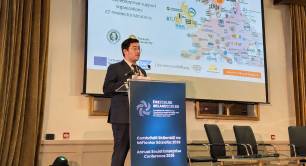
Jerry Buttimer, Irish minister of state at the department of rural and community development and the Gaeltacht (the districts in Ireland where Irish Gaelic is spoken as the predominant language), opened the conference by welcoming delegates in Irish Gaelic.
Buttimer then celebrated the EU’s adoption of Irish Gaelic as a working language. He said: “It speaks to a significant milestone for us in terms of our linguistic and cultural engagement with the European Union.”
The conference was officially part of Ireland’s presidency of the Council of the EU, and had a dual focus: EU support for the social economy and the state of social enterprise in Ireland. Buttimer highlighted the slogan for Ireland's presidency of the EU Council "Ní neart go cur le chéile" ("There is no strength without unity").
A key aspect of that unity, according to a number of speakers, is the importance of a shared language to communicate the impact social enterprises are making.
Patrizia Bussi, director of the European Network of Social Integration Enterprises, told delegates a collective voice can overcome the comparatively limited resources social enterprises have to ensure the sector’s message is considered in crucial EU negotiations.
She said: “We need to develop a common message that shows the reality of what you are doing every day on the ground and demonstrate that the sector is important.”
And those crucial EU negotiations are happening right now. As flagged by Sarah De Heusch, director of Social Economy Europe, the European Parliament is currently deciding on its 2028-2034 budget.
It was an opportune moment, then, for Euclid Network to publish the main findings of the European Social Enterprise Monitor 2026, its biennial survey-based study on social enterprises across Europe, as covered in our story this week.
The study found that 364 different individual or combined legal forms and statuses were being used by a sample of 2,814 social enterprises from 38 European countries. With that level of “confusion” over legal forms and statuses, as Euclid’s policy lead Toby Gazeley branded it, there is all the more emphasis on finding a clear narrative to tell the story of the impact the sector is making.
Of the social enterprises sampled, 30% said they use at least one third party verification or certification, the most common of which is People and Planet First, stewarded by the Social Enterprise World Forum (SEWF).
Gerry Higgins, SEWF founder and managing director, told me that: “In a market full of greenwashing and social washing, [People and Planet First verification] confirms that an enterprise exists to solve a social or environmental problem and reinvests the majority of its profit in that purpose.”
This week has been People and Planet First Week, a campaign run by SEWF to celebrate social enterprises, co-operatives, benefit corporations and more. With EU budget negotiations delicately poised, it must be hoped People and Planet First Week, and other similar advocacy efforts, can deliver the “strength with unity” and common language necessary to secure the support social enterprises need to thrive.
This week's top stories:
Chatterbox founder announces exit as social enterprise strikes Preply deal
European social enterprises look to third party certification in face of ‘confusion’ over legal form
New podcast: How can social investment help to solve the UK’s housing crisis?
Emerging start-ups to benefit from GLL health and wellbeing social enterprise incubator
Top image: a panel at the SERI conference 2026. From left: Sarah De Heusch, Director, Social Economy Europe; Wieteke Dupain, CEO, Euclid Network; Rebecca Sunnus, European Economic & Social Committee; Patrizia Bussi, director, ENSIE; Philip O’Donnell, Local Development Companies Network. Picture by David Lyons / Pioneers Post.

| Ready to invest in independent, solutions-based journalism?
Our paying members get unrestricted access to all our content, while helping to sustain our journalism. Plus, we’re an independently owned social enterprise, so joining our mission means you’re investing in the social economy. |