
The Editor's Post: What place will the impact economy have in Burnham’s Britain?

A new prime minister means uncertainty for the UK’s impact economy, and this week’s move of the Office for the Impact Economy out of the “heart of government” is leaving more questions than answers. How could the sector future-proof its relationship with government? It could look to recent developments in Australia.
On Monday, Andy Burnham, the UK’s new prime minister, promised “the biggest changes in the last forty years” as he entered Number 10. What that means for the countless social enterprises, mission-driven businesses and impact investors driving social change in communities across the country is hard to predict, so we asked impact leaders for their thoughts – make sure to read their analysis here.
On Tuesday, the government announced it moved the Office for the Impact Economy from the Cabinet Office to the Department for Culture, Media and Sport (DCMS), as part of a swift reorganisation of the “machinery of government”.
‘Ouch’, I thought at first. The Office for the Impact Economy was created only eight months ago, to coordinate government policy to boost the sector. One of its key selling points was that it was located at the “heart of government” – showing the impact economy agenda was high in the government’s priorities, in a strategic position to easily work across departments – which was seen as a massive win by the impact community.
Reactions to Tuesday's move were mixed, as you can read in our top story this week. Some see it as a worrying sign of deprioritisation. Others find some silver linings, and even an opportunity – like Social Investment Business’s Jack Wakefield, who outlines his argument in this column.
But one concern is that the scope of what the government calls the ‘impact economy’ might be narrowed down. Its definition is broad by design: reaching out beyond the mission-first enterprises and social investors that make the well-established “social economy”, and including a broader range of purposeful businesses and “finance-first” impact investors. Now, large businesses and investors in this category might raise an eyebrow at the idea of being sent to DCMS, feeling they’re not taken seriously, I’m told.
Let’s also remember the ‘impact economy’ is a recent concept. Some argue it is an odd mix not really rooted in reality, somewhat artificially constructed to mirror the field of ‘impact investing’ (which, as Pioneers Post readers will know, is currently under fire for not always putting impact first.)
Others say bringing all these stakeholders together is simply the most efficient way to boost positive impact. In any case, it is new on the government’s radar, and as a result it won’t have very solid roots. It has also lost its main backer in government: Darren Jones, former chief secretary to the prime minister, was sent to the backbenches on Monday.

The Burnham government doesn’t lack champions of the mission-driven businesses and investors that make up the impact economy – starting with the PM himself – and positive signals policy-wise help offset concerns about the Office for the Impact Economy. But it might just be that support for the sector will take a different shape, and that it will no longer be led by the same actors that previously pushed the impact economy agenda on the government.
Cliff Prior, former CEO of Better Society Capital and GSG Impact, suggests a potential solution: “What if we have a clear, strong, sector voice from our own side?...Would it matter if the sector had that heft, to have strong connections across all relevant government departments, not just one that gets moved around every few years?”
As it happens, this week brings us a perfect example of what this could look like from down under: Australia’s social enterprise community published its first ever national strategy on Monday.
It is not led by the government, nor carried by a single organisation, but co-designed by the community: nearly 500 people representing organisations from across the sector came together through workshops, meetings, surveys, and a vote. Inevitably, the strategy is not a precise step-by-step plan of action, but more of a high-level guide with joint objectives and challenges to overcome, and it gives the sector a common voice. The government is welcoming it – and it’s fair to say it will make working with the sector much easier for them.
If the UK’s impact community managed to show such a unified voice, perhaps it would give it substantial gravitas and recognition within the government, as Prior suggests, and we wouldn’t be so worried every time a new PM turns up – which seems to happen rather frequently these days.
This week's top stories:
Mixed reactions as UK’s Office for the Impact Economy is pushed out of the ‘heart of government’
Australian social enterprise community launches ‘sector-owned’ national strategy
My quest to give every baby a chance to survive and thrive in rural Uganda
What will the Burnham government mean for the UK’s impact economy?
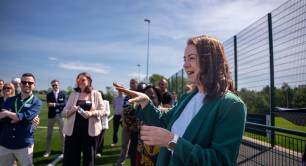
Top image: Andy Burnham visits the Hare pub on Thursday. Picture by Simon Dawson / No 10 Downing Street.

| Ready to invest in independent, solutions-based journalism?
Our paying members get unrestricted access to all our content, while helping to sustain our journalism. Plus, we’re an independently owned social enterprise, so joining our mission means you’re investing in the social economy. |